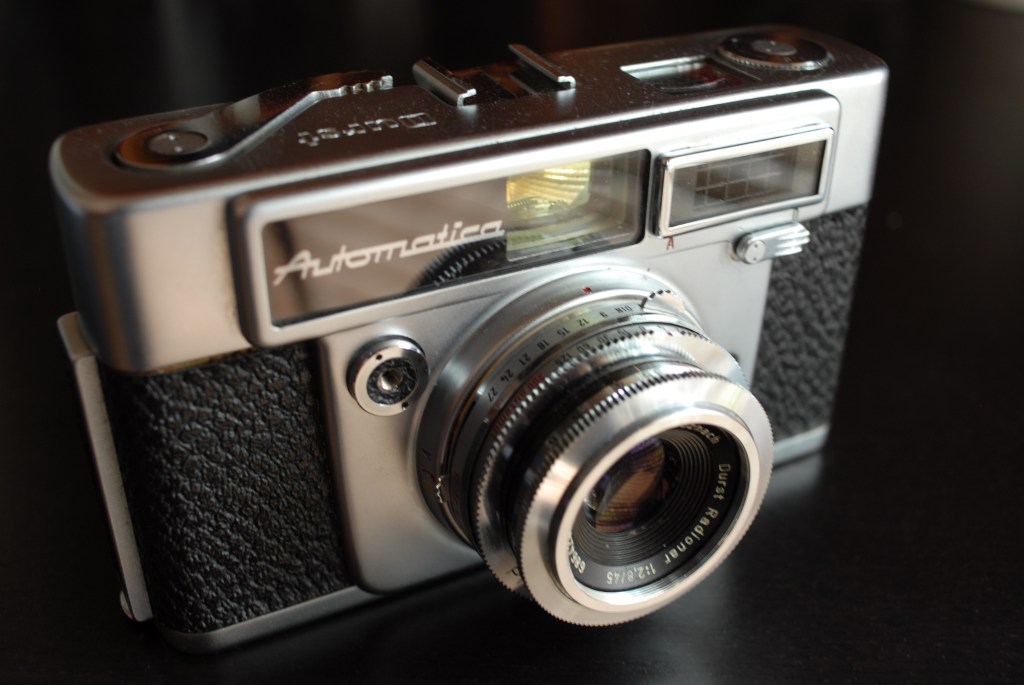
Much has been said about the Durst Automatica camera. When I bought mine at a flea market in 2008 I thought it was an unusual brand rangefinder. I knew Durst made copiers but not cameras. Later I found out it was in fact a viewfinder camera. It had no rangefinder built in. You had to guess the subject distance and use the distance scale or use zone focusing.

But it was a such a cool camera from the 1960’s. Nice design by the Italian makers. The advance lever sat flushed with the top plate of the camera giving the top plate a clean flat top. During the film advance motion, the lever moves up above the top plate to enable it to rotate fully to advance to film. The film rewind knob on the other side of the top plate also sat flushed and pops up when a button at the bottom plate is pressed to release it.
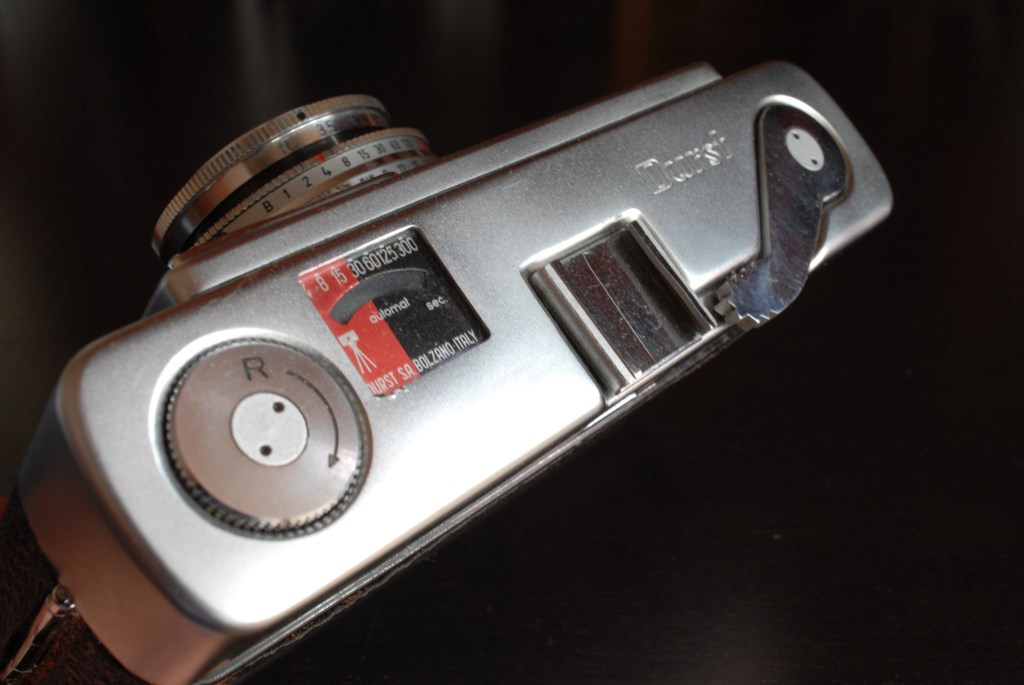
The shutter release button sits in the front plate and is driven by a pneumatic mechanism which gives it a slightly different feel and sound from other mechanical shutter release mechanisms.
Mine came stored in its original case and was in very good condition. I have never used it before to take photos until now in 2023. The Prontor-SVS leaf shutter seems to fire at the correct speeds except for the slower speeds 1/2 and 1 sec where it seems a bit more sticky.
By the way the camera has a very unusual aperture priority system (probably one of the first aperture priority systems in the world). The f-stop used for aperture priority mode is dependent on the ISO of the film that you use. For example, if you use an ISO 400 film, the only f-stop you can use for aperture priority is f22, f16 with ISO 200, f11 with ISO 100 and so on. This is because both the aperture priority ISO setting and aperture priority f-stops are on the same ring of the lens. Turning the ring to set the ISO of the film used for aperture priority mode will set the f-stop at the same time.
The aperture priority AE is set by turning the lever in the front of the camera from O to A (in red) and setting the shutter speed at its max 1/300s (also in red). Once aperture priority mode is set, the camera will automatically choose the shutter speed using the built in selenium light meter. If you wish to use manual exposure by manually turning the f-stop and shutter speed rings on the lens, you simply just set the lever from A to O.
Loaded up with expired Walgreens ISO 100 colour film, I set out to the Eastern suburbs of Sydney, Australia on a fine winter’s day to test run the Durst Automatica. Is the selenium meter still working? I don’t know but since it has been kept in its original leather case, I am keeping my fingers crossed!
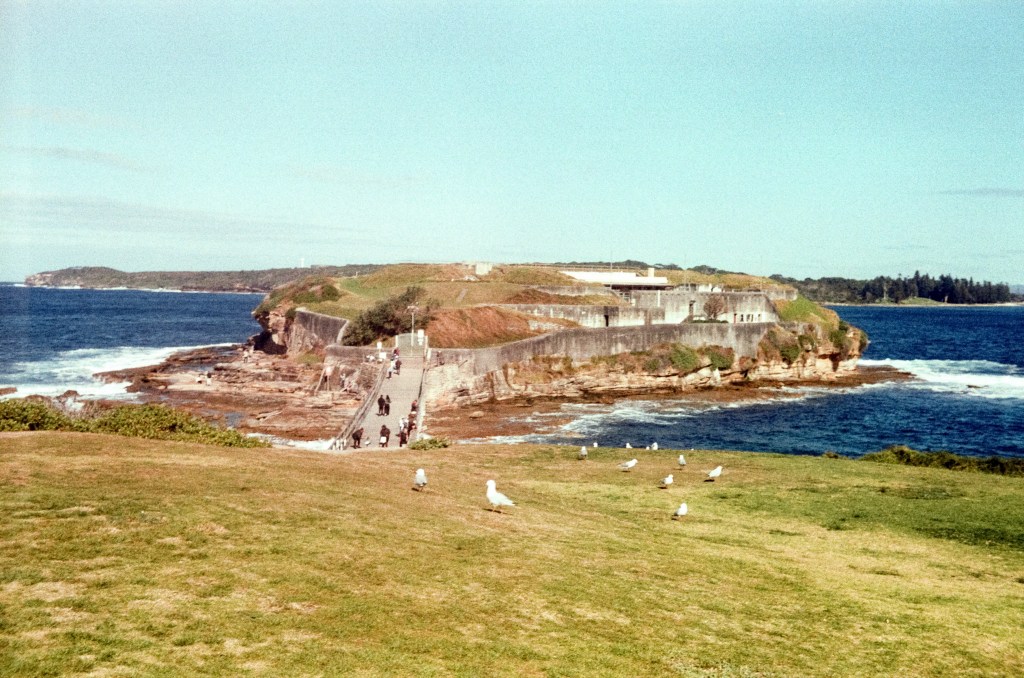
I drove all the way to the southern-most tip of the Eastern suburbs to La Perouse and parked at the Bear Island Fort parking area. This is where they filmed the end action scene of Mission Impossible II. Setting the camera on AE mode, I shot everything on f11 (ISO 100). I guessed as it was a bright sunny day, shooting at f11 would be safe even if the selenium meter wasn’t working.
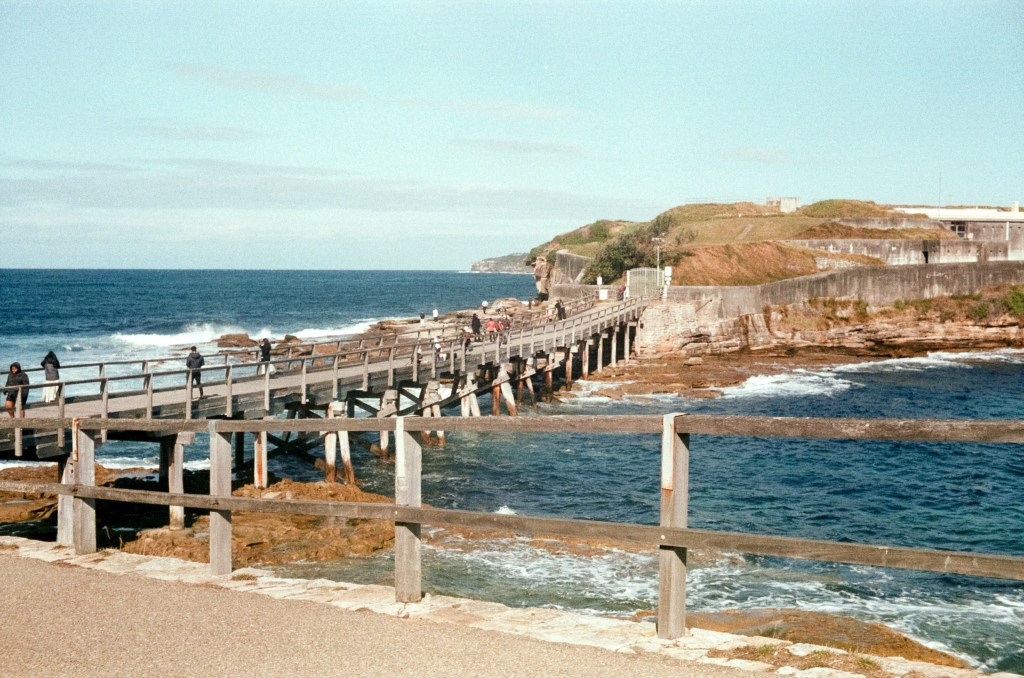

This camera was built with zone focussing in mind. The focus ring had a click stop at 10 ft which was the average distance for group pictures. So I either left the focus ring at 10 ft or focused to near infinity as needed. You know that you are at 10 ft focus distance without looking because of the click stop. At f11, most subjects in my photos were in focus. I was pleased with the sharpness of the Schneider-Kreuznach Radionar 45mm f/2.8 lens on the Automatica.

Bear Island Fort bridge where Tom Cruise chased after the baddies on his motorbike

University of New South Wales at the Eastern suburb of Kensington.
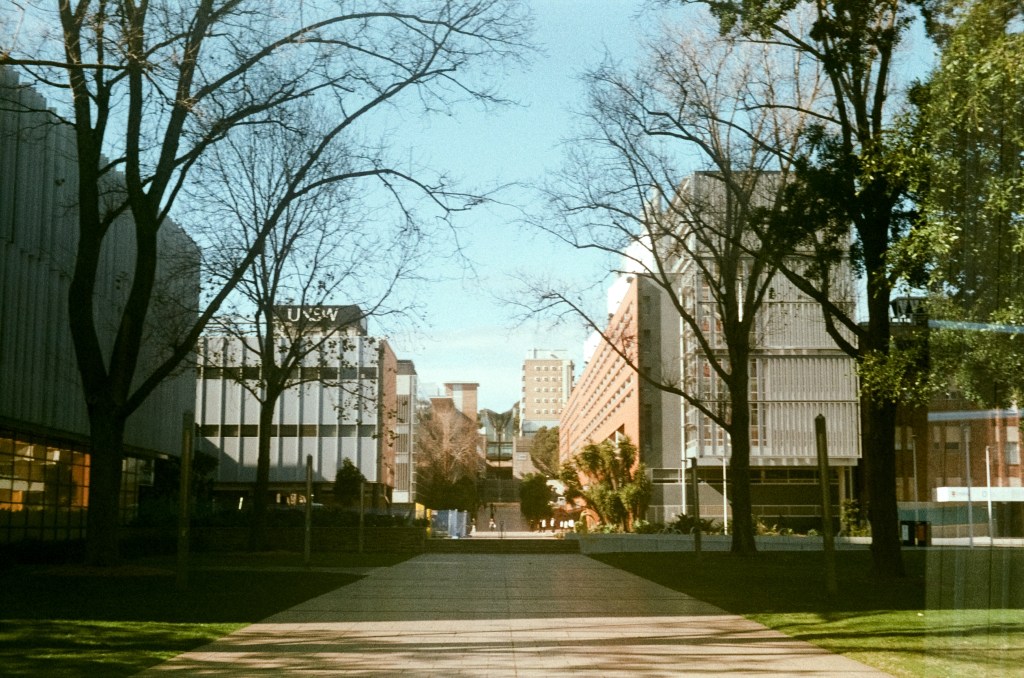
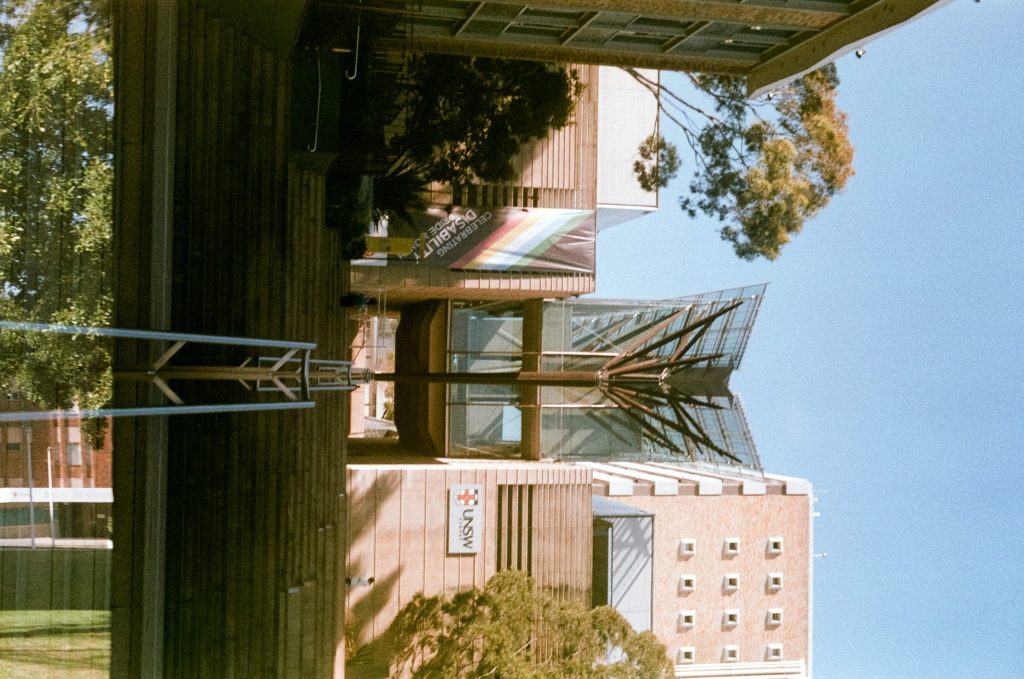
I think it was me not fully advancing the advance lever of the camera – there were a couple of pictures that were double exposed at the border between each frame due to the film not advancing fully by 1 full frame when the film was advanced. See the adjacent borders of the pictures above.
When I tried to rewind the film after taking the last photo, I could feel a lot of resistance trying to rewind the film. After trying to use some force to rewind the film, I felt a sudden give. I knew something had given in the film chamber. Not risking exposing the film while outside, I took the camera back to the darkroom at home before opening up the camera back. The film had broken away from the film canister and I had to manually rewind the film from the camera spool in the dark.
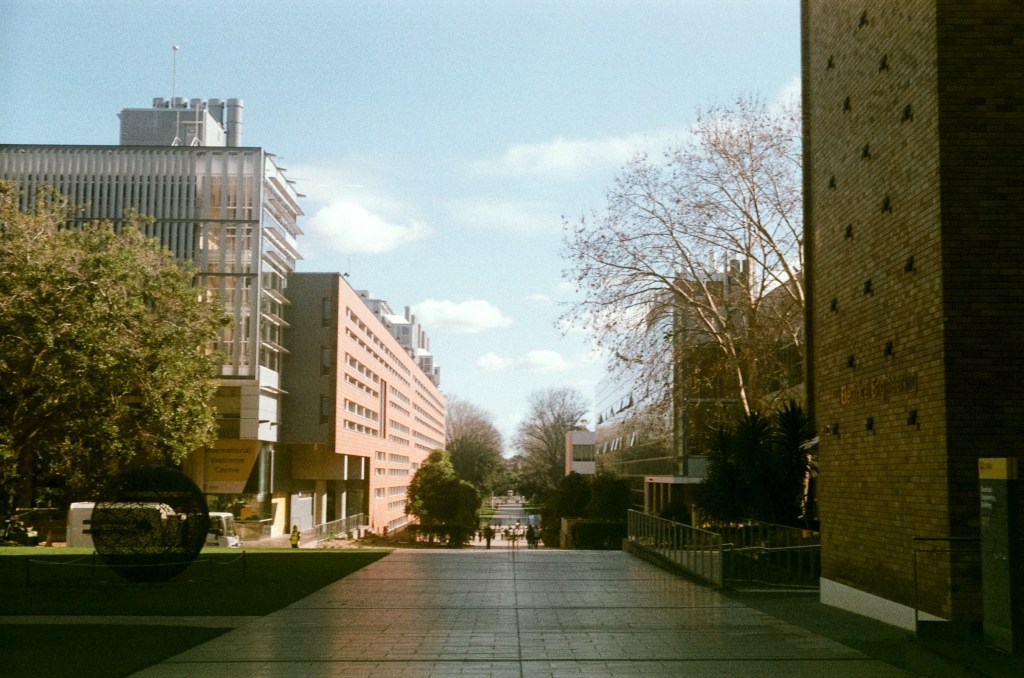
All in all, I was pretty pleased with the performance of this vintage Durst Automatica camera.
Here is a nice write-up of the Durst Automatica camera by Mike Eckman: https://mikeeckman.com/2023/04/durst-automatica-1956/
Thanks for reading.

 AK Siong's Photo Gear Journey