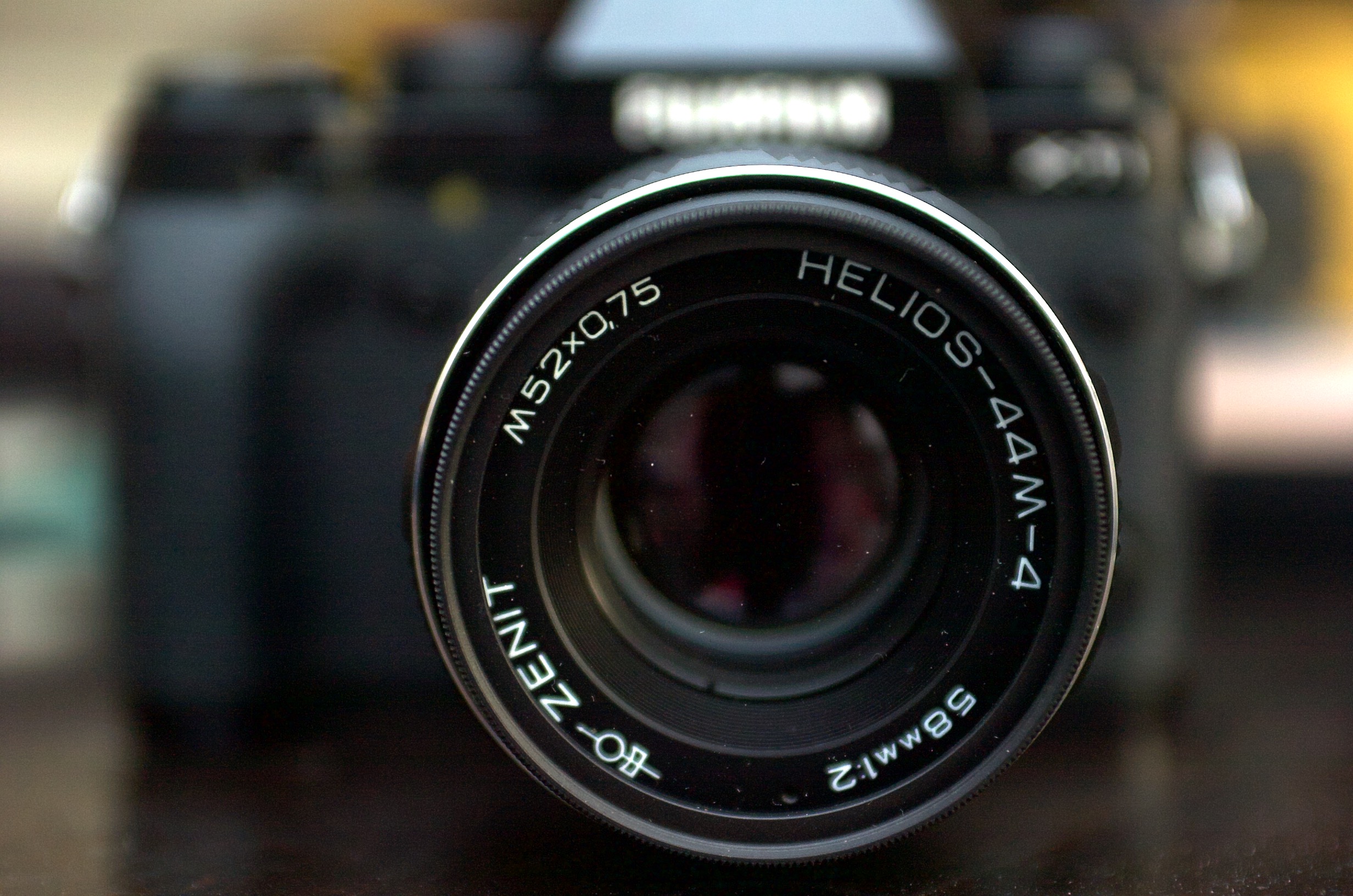
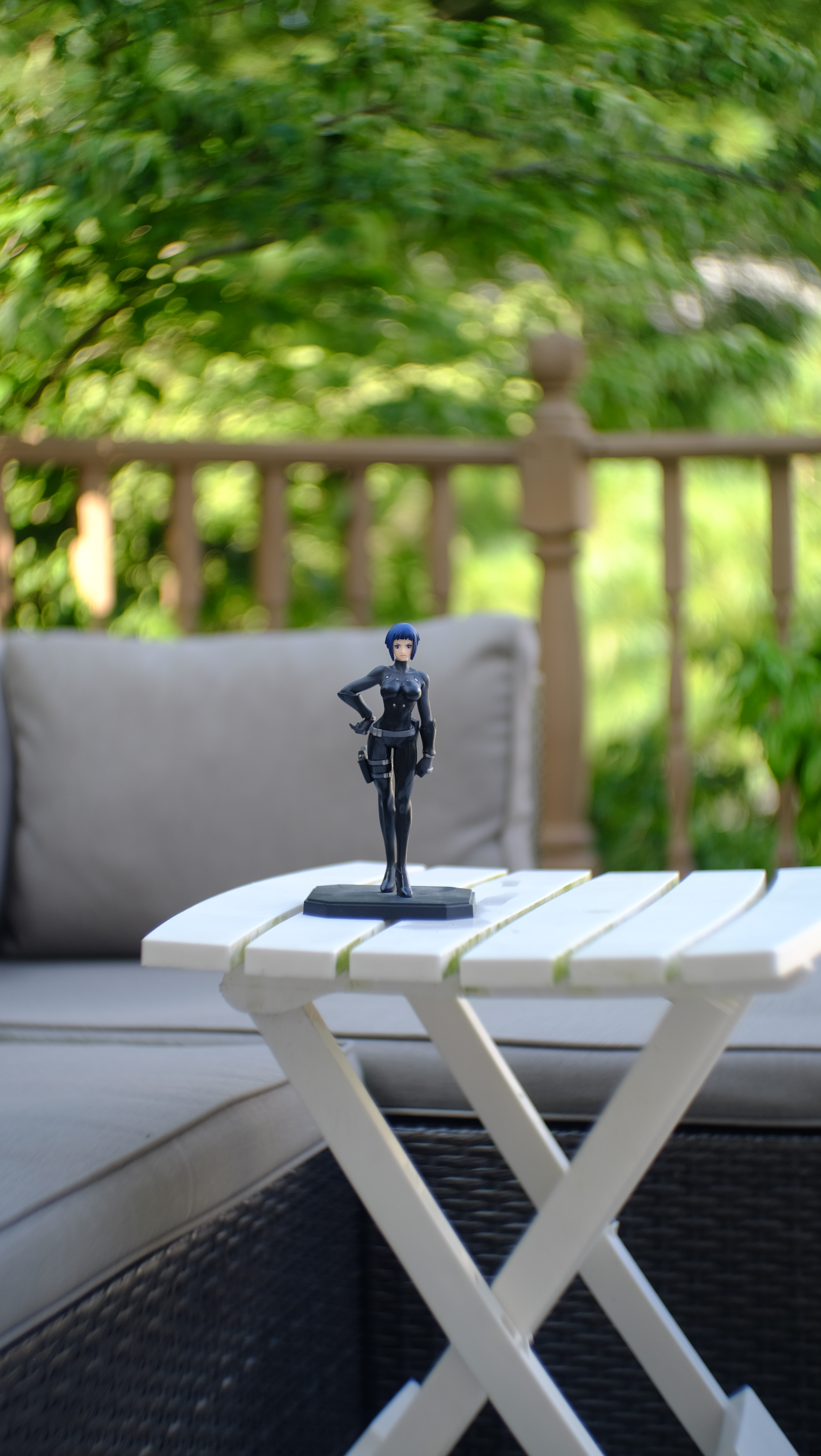
I must admit I love the swirly bokeh of the Helios 58mm f2 lens. It suits portraiture best when the right conditions are met for the bokeh to swirl around the subject.
The right conditions usually mean the right camera to subject distance, in this case from about 2 to 4 metres for the camera to subject distance.
The right background needs to be chosen. The swirling effect of the bokeh seem to come from imperfect formation of light circles from the center of the frame (where they are round) to the edges of the frame (where they are elliptical). So the background should have many points of light. For example, light coming through leaves or light coming from the many buildings in a city background at night or light coming from a lighted Christmas tree. It is a unique imperfection of the Helios lens design. With modern lenses perfectly designed through the aid of computers, you only get perfectly round light bokeh.
Lastly, you need to open up the lens to its largest aperture – f2. The subject matter is best placed in the center of the frame as that is where the lens is sharpest at full aperture. The sharpness falls off steeply toward the edges at this aperture.
The Helios-44 lens comes in many variants and were made by several different former Soviet eastern bloc manufacturers. Camerapedia has a good description of the many variants.
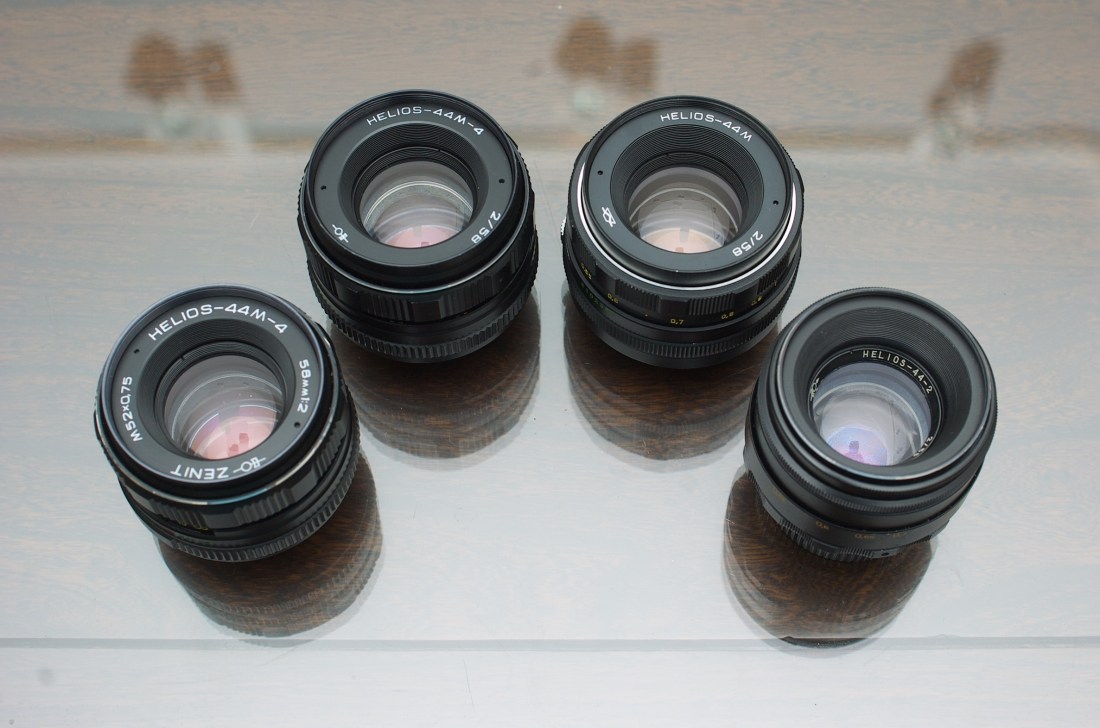
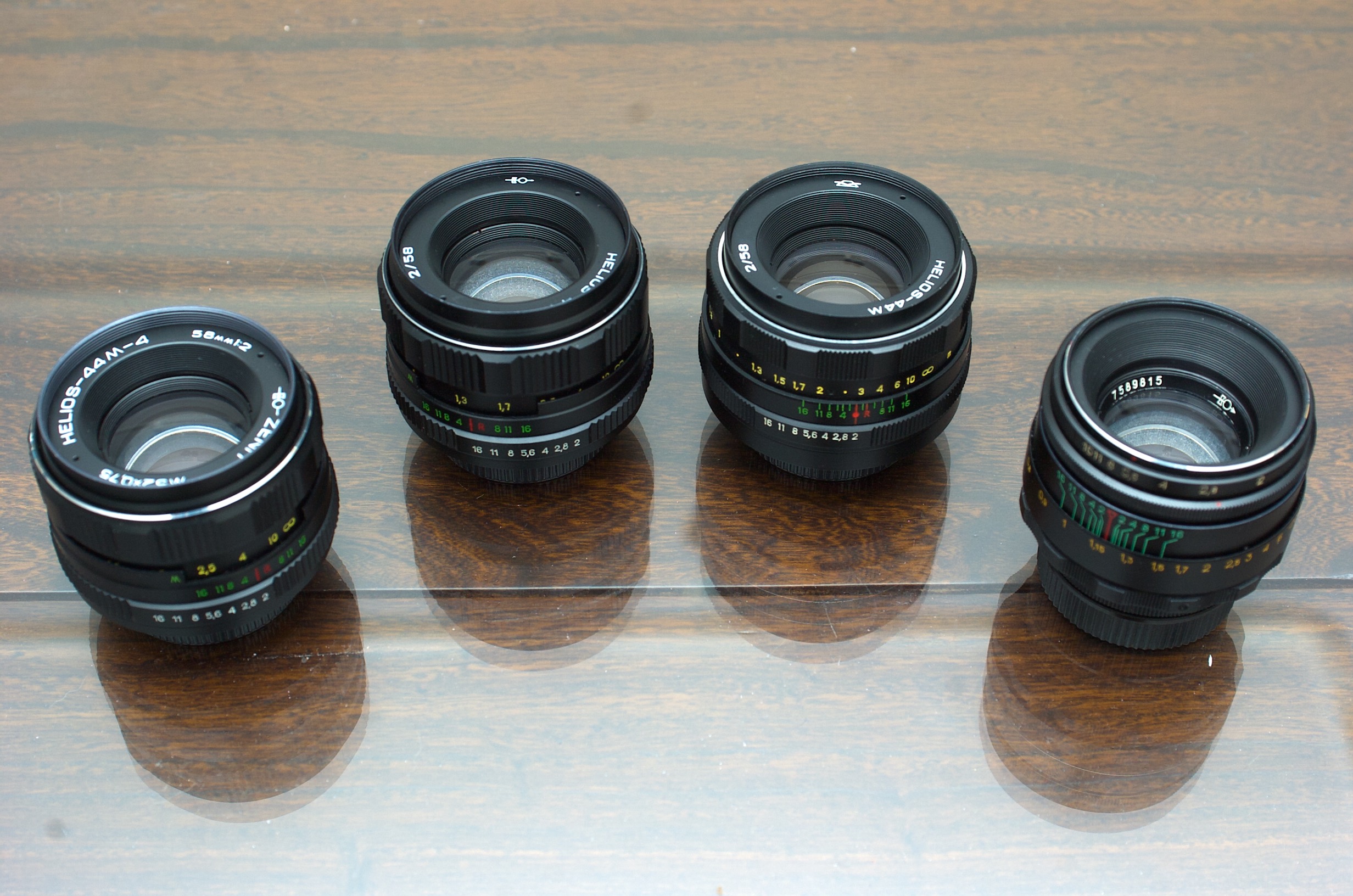
Recently I conducted a quick and dirty comparison of four Helios-44 lenses for their swirly bokeh and center sharpness. They are, in order of manufacture year, the Helios-44-2, Helios-44M, Helios-44M-4 (2 lenses).
These were attached to a Kipon M42-FX BAV-Eyes 0.7X adapter and mounted on a Fuji X-T1 to have full lens coverage with no crop (and hence full extent of the swirly bokeh) on the APS-C sized Fuji sensor. All shot at their widest aperture of f2.
The comparison photos below:-
Helios-44-2 (8 blades, stepless aperture)
Helios-44-2 SN7589615
Helios-44-2 SN7589615
Helios-44M (8 blades)
Helios-44M SN8102357
Helios-44M SN8102357
Helios-44M-4 (6 blades)
Helios-44M-4 SN87405245
Helios-44M-4 SN87405245
Helios-44M-4 (6 blades)
Helios-44M-4 SN88158346
Helios-44M-4 SN88158346
The verdict? Seems like all have a similar bokeh effect and more or less the same center sharpness (handheld). Colour is warmer from the Helios-44-2. Perhaps this difference is from the coating of the lens – single coated vs multi-coated lens. I am not the expert here. Perhaps someone could tell me.
The 44-2 and older 44M-4 (SN87405245) do not focus to infinity. Hence the only usable ones to me for photography are the 44M and newer 44M-4 (SN88158346). This was the primary reason I did the test.
These lenses are fun, relatively cheap and have a cult following. In fact so much fun, I am taking one out for a spin in the near future and hopefully post more swirly bokeh photos in this blog.
Recently I acquired a Nikon SLR with an AF-S DX Nikkor 35mm f1.8 G lens attached to it. While I was not planning to get the lens, I thought this was a bonus.
This particular Nikon lens was released in Feb 2009 primarily for Nikon’s DX range of DSLRs (digital SLRs). The lens was primarily targeted as an inexpensive, large aperture option for users of the entry-level (D40 / D40X /D60) series of DSLRs. It is small, light and cheap and had relatively good reviews. It had the silent-wave auto-focusing system, meaning that the autofocus mechanism was in the lens and not the body, theoretically making it faster to autofocus.
When my lens arrived, it looked in good condition. The glass was clear, the focusing ring was smooth. However, when I attached it to the camera, it could not focus fast enough. It kept hunting for focus. I thought it was the camera body, so I changed the body. Same issue. Cleaned the electronic contracts, tried it outdoors in bright light and larger apertures, no difference. The lens still hunted for focus.
Eventually I looked to the internet to see if anyone else had similar problems. There were a couple of posts mentioning focus hunting issues with this model of 35mm lens. One poster, disassembled his lens and cleaned the gears of the silent-wave mechanism. Apparently that got rid of the problem. I decided to do the same.
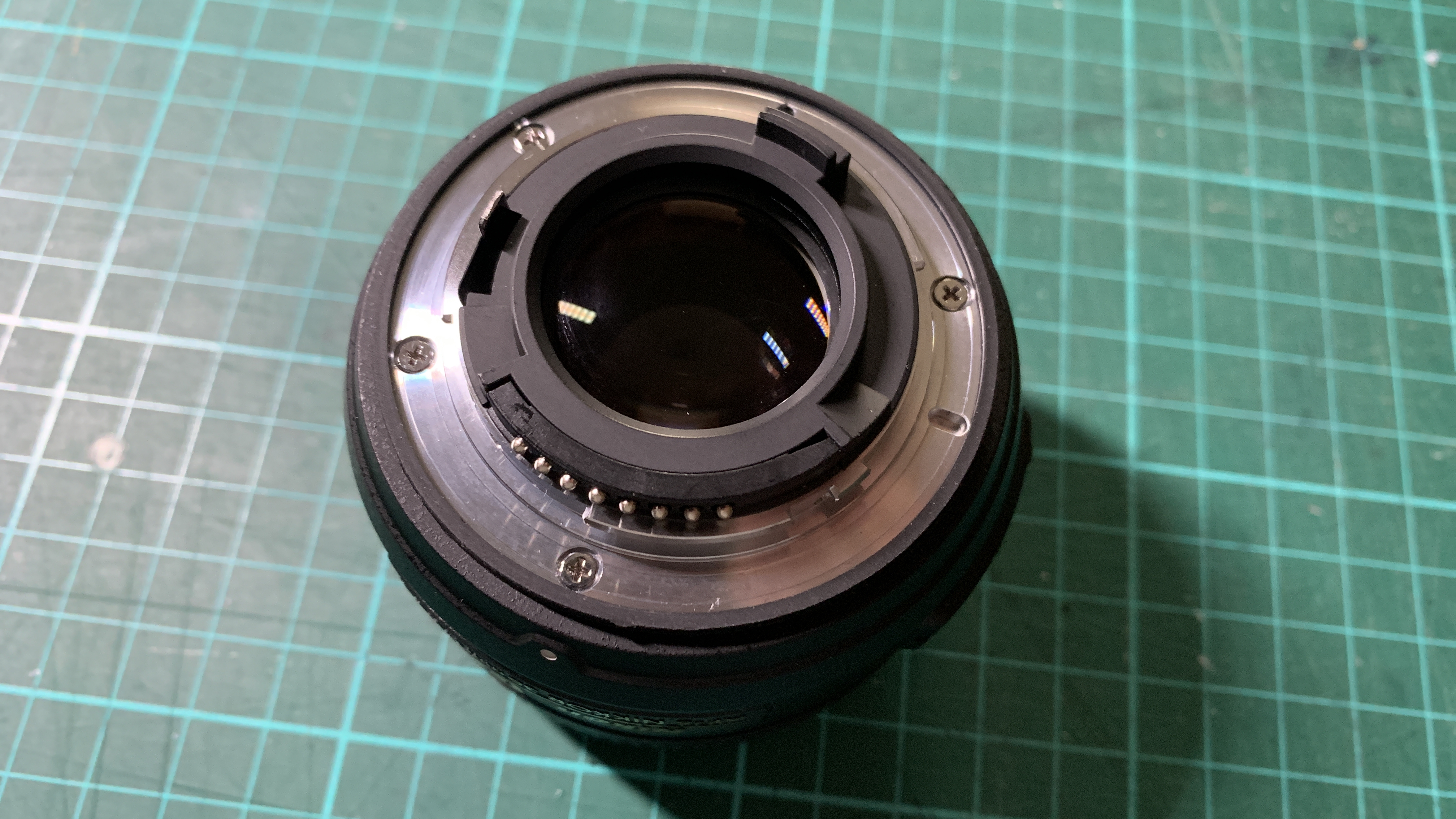
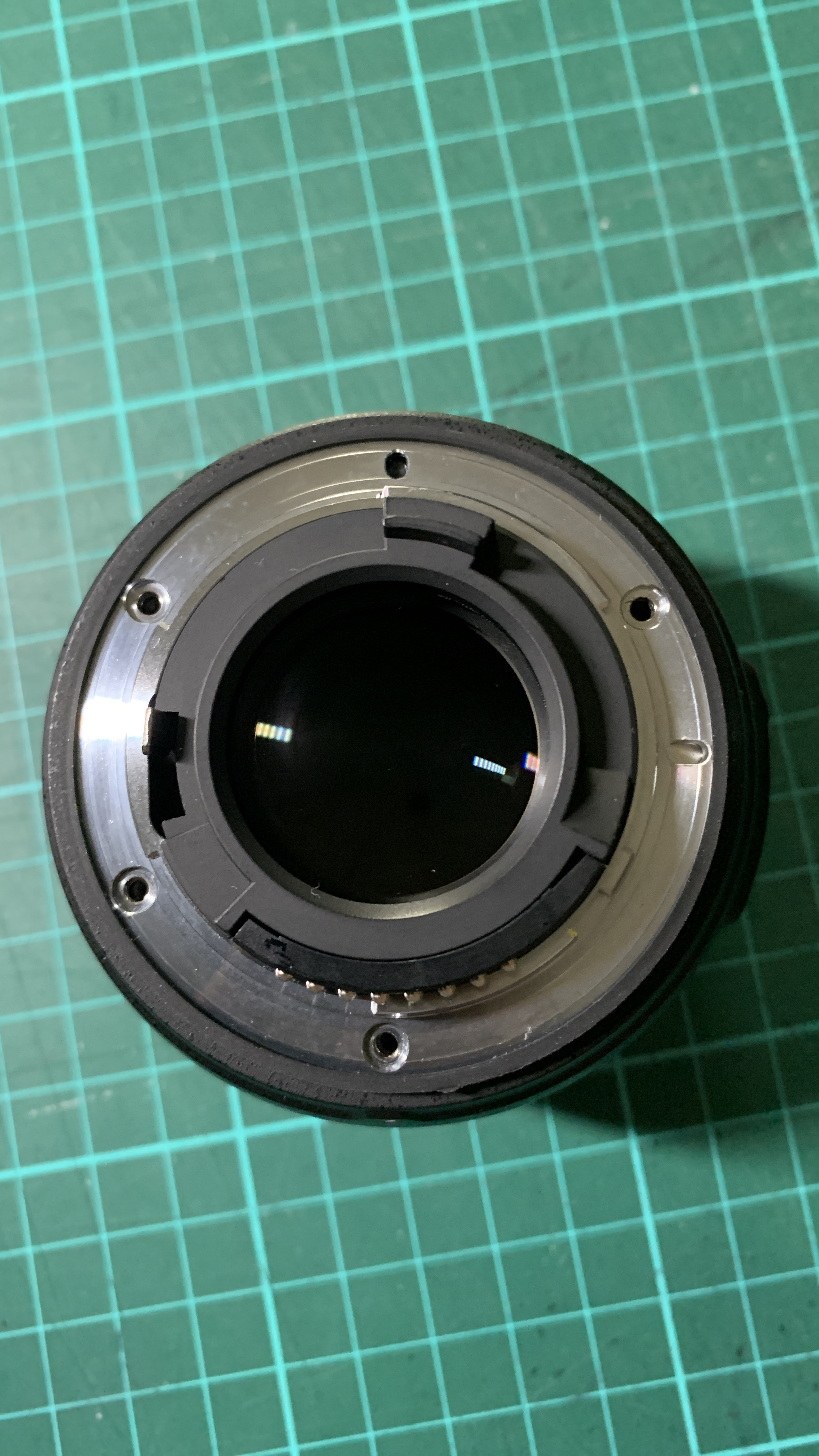
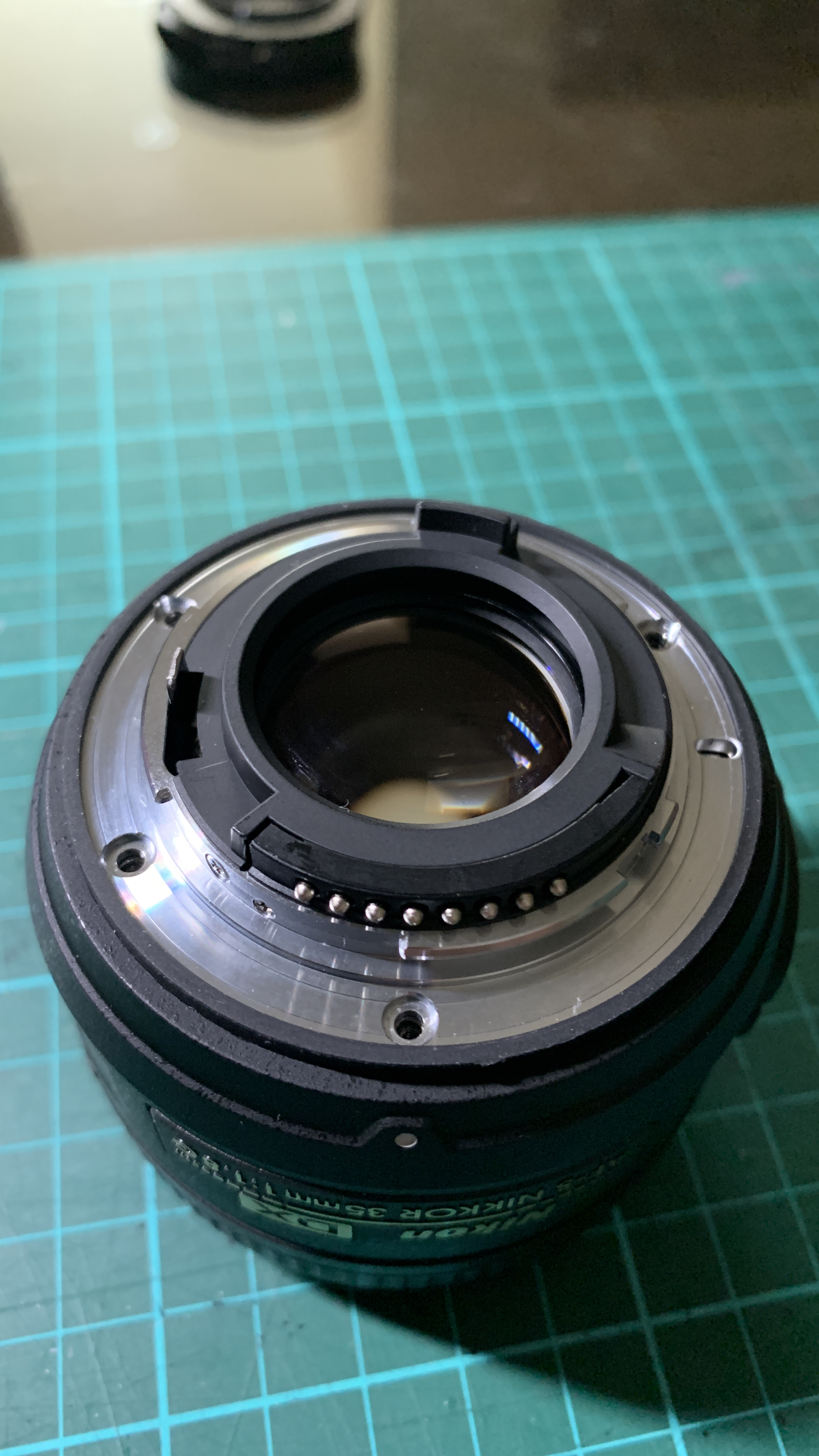
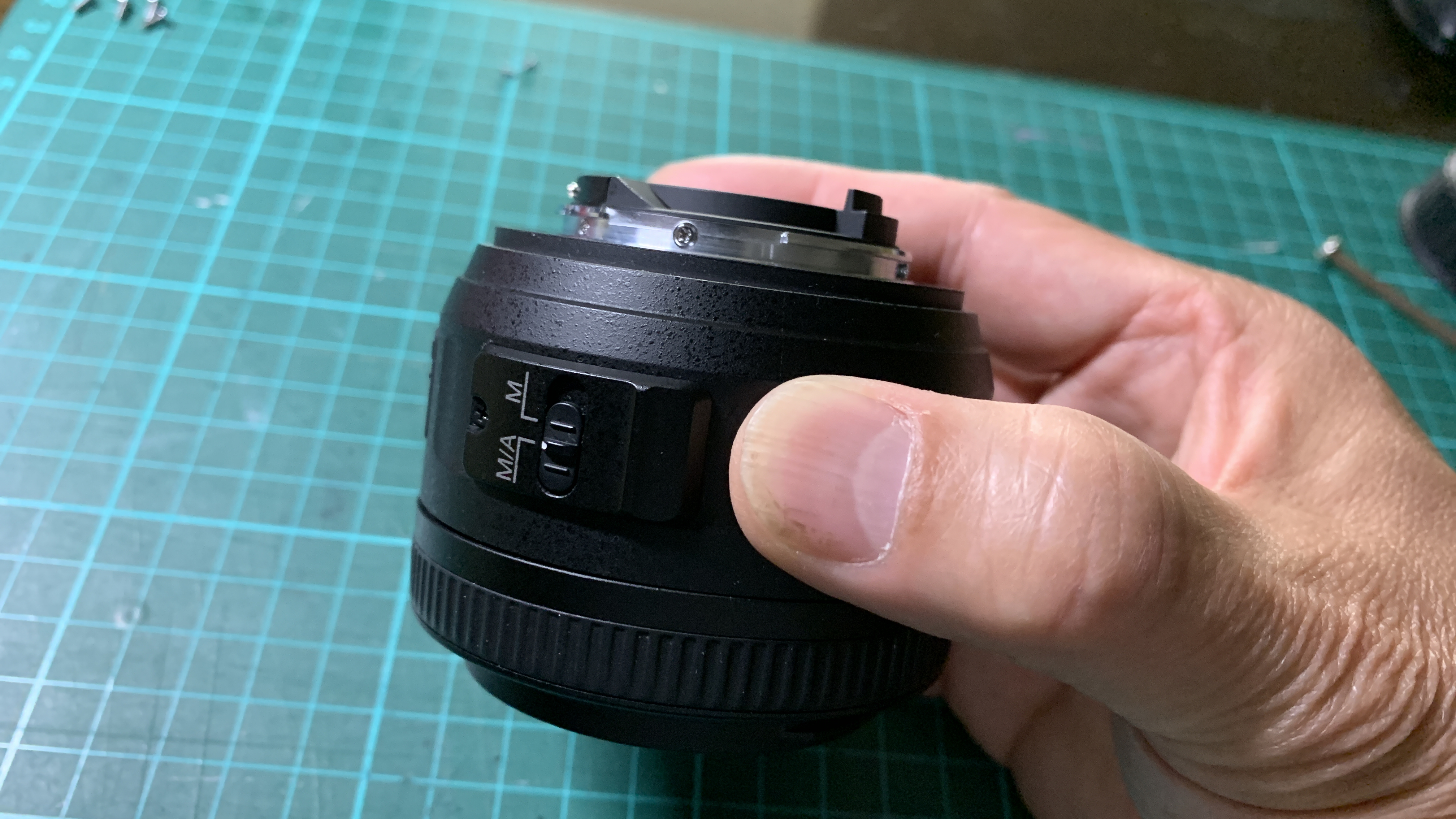
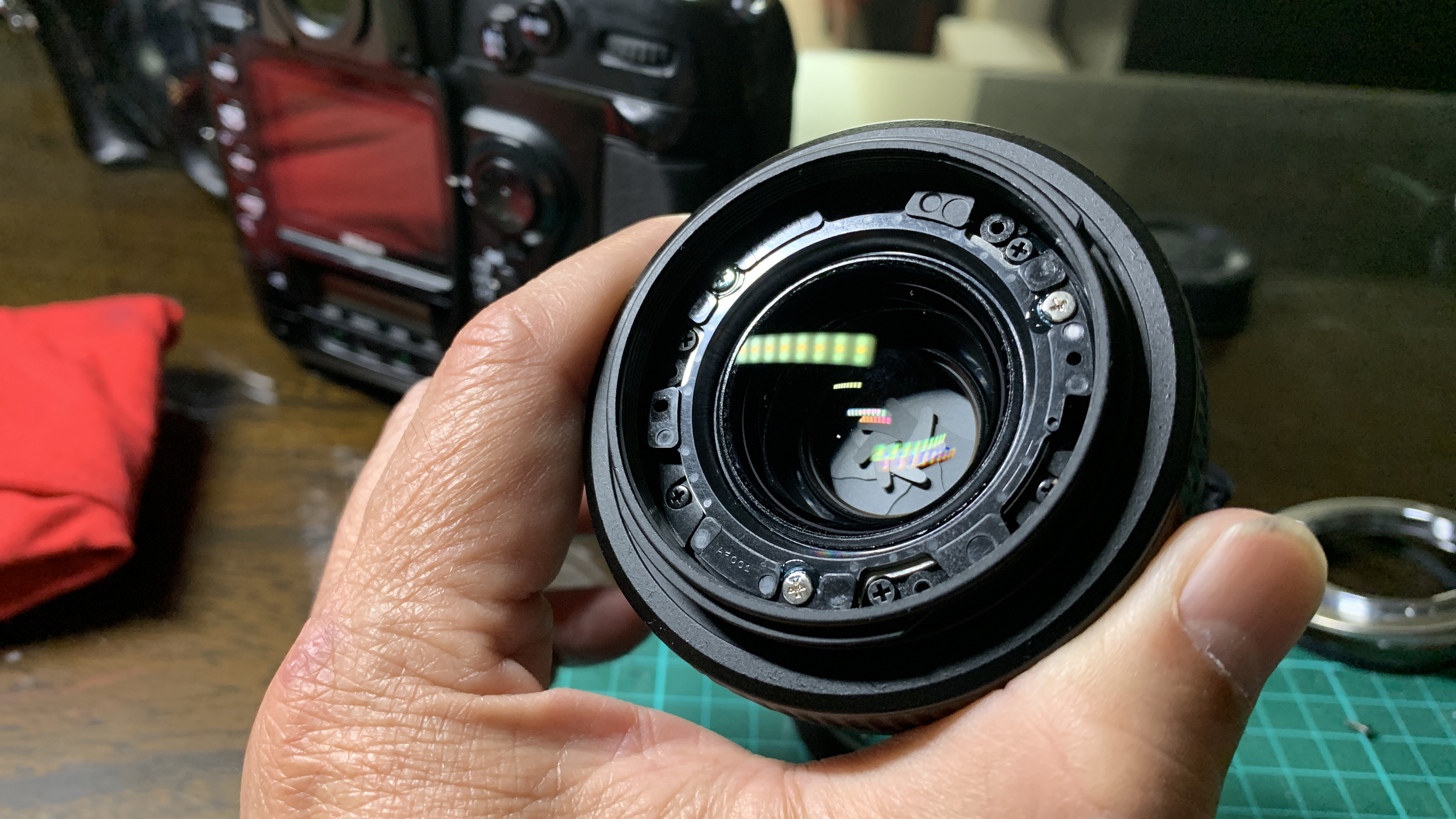
Starting with the rear of the lens, I unscrewed the 4 small screws securing the mounting ring.
Next 3 screws to come off were the ones holding the black plastic part of the lens mount in place.
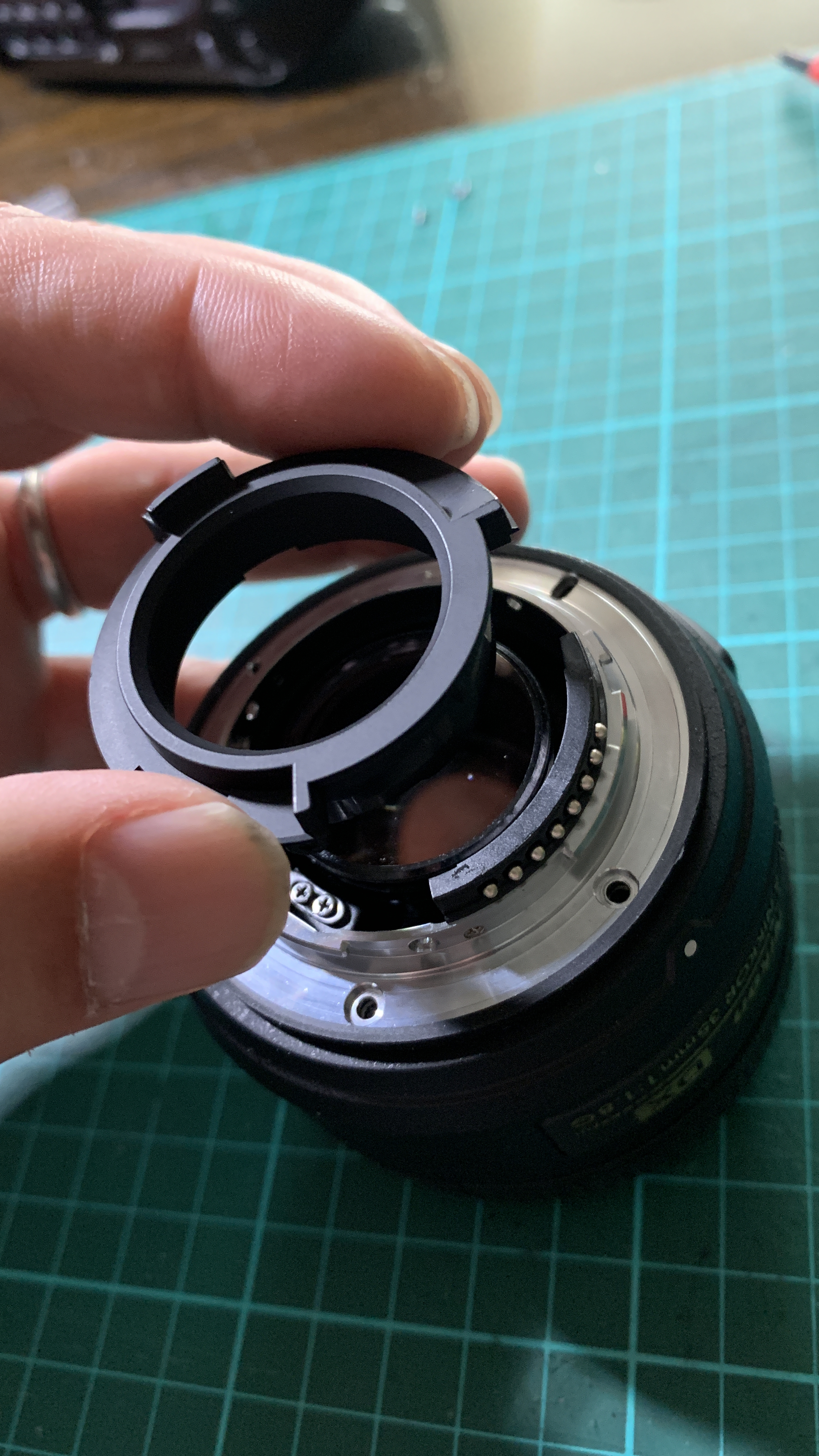
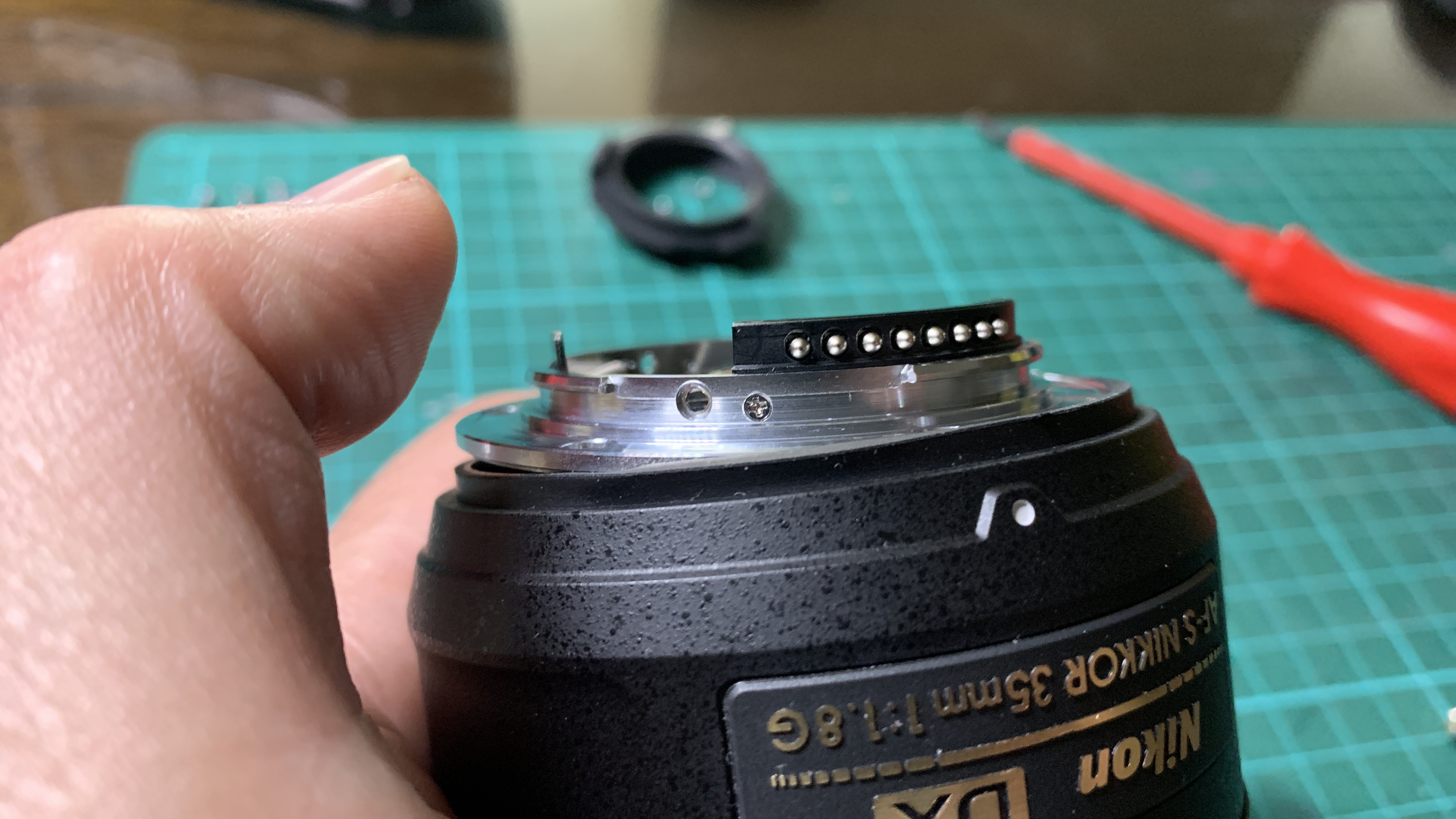
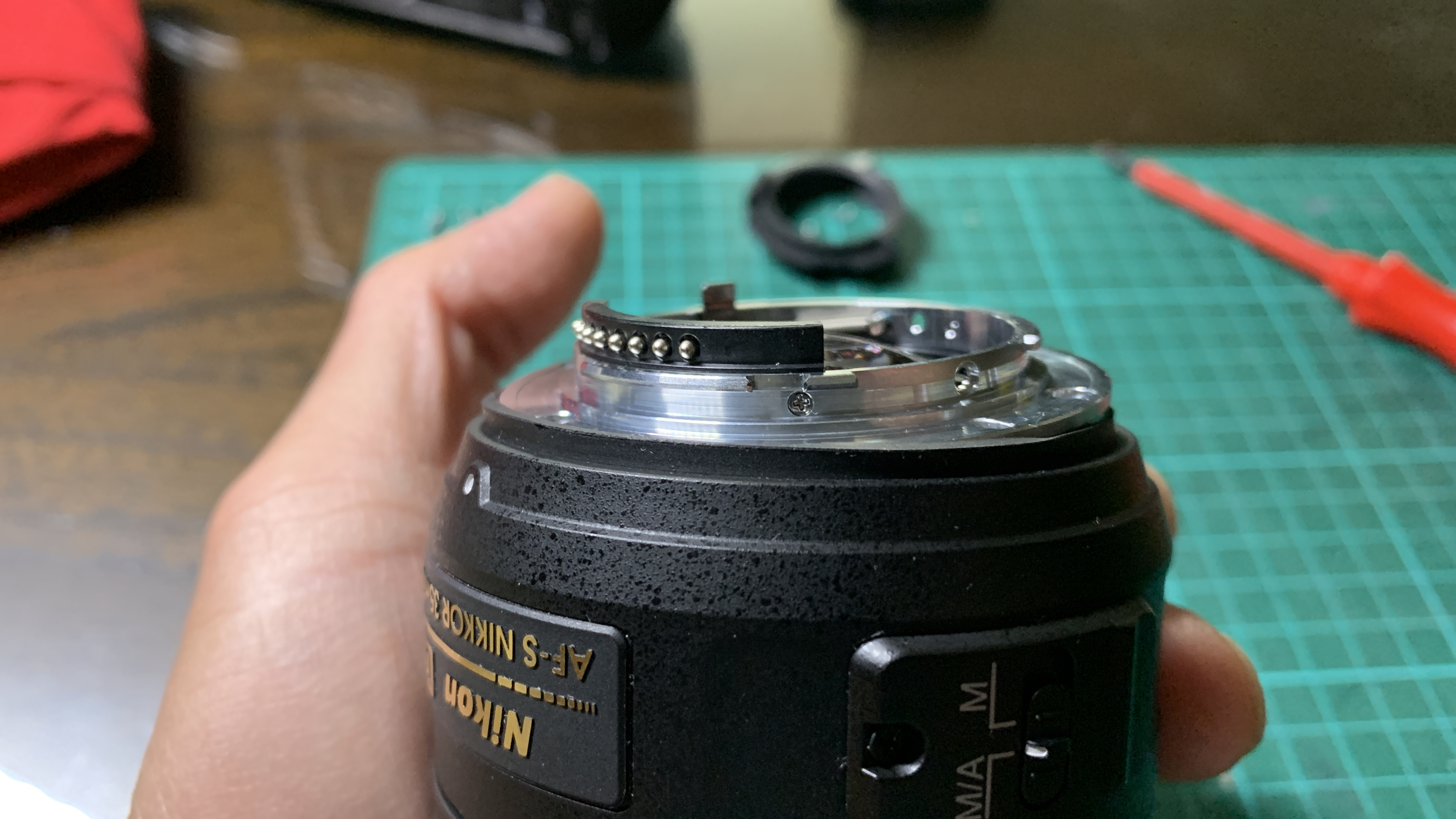
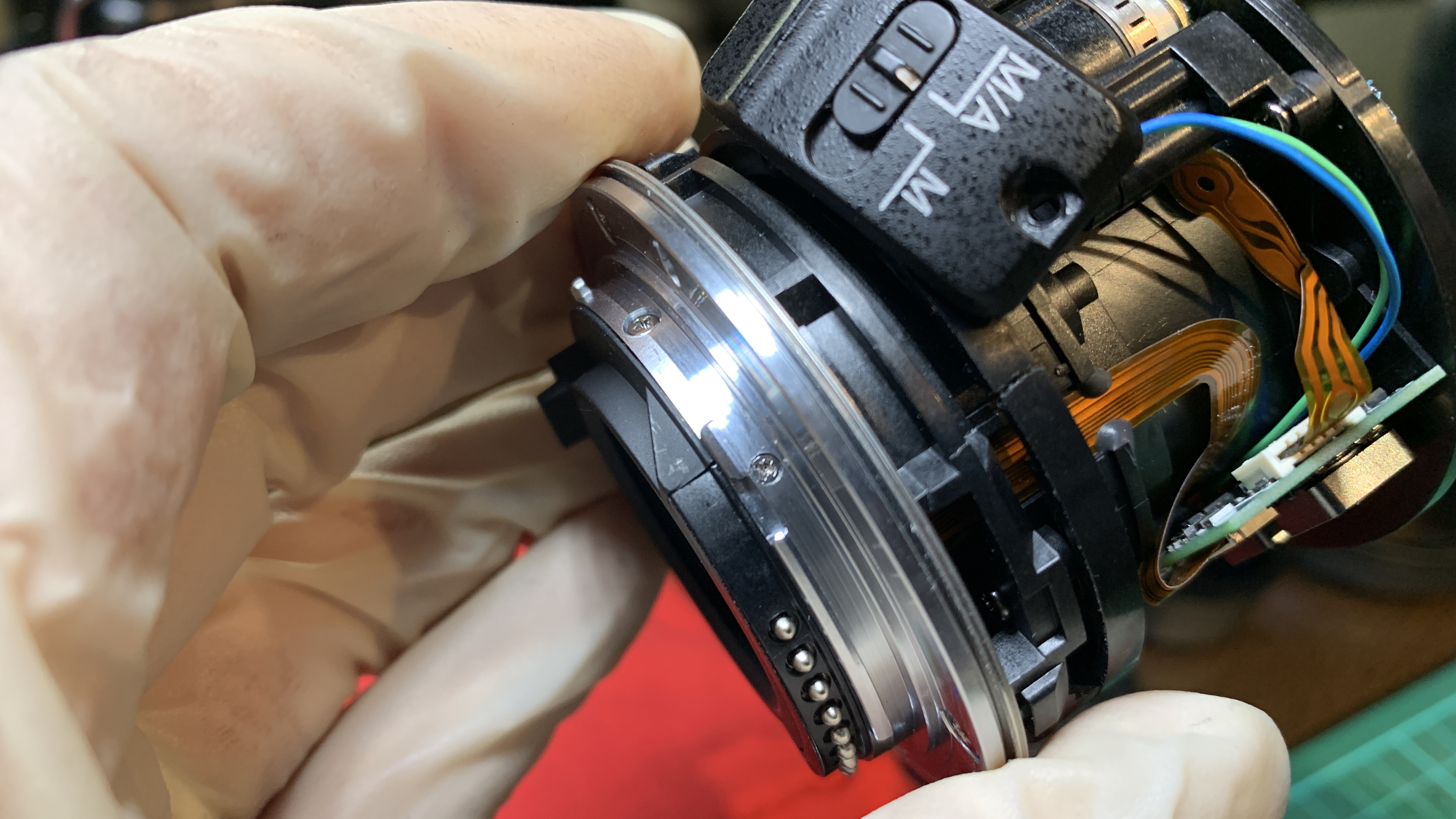
Before the metal lens mount ring could be detached, the lens contact points had to be released from the mount. This was held in place by 2 small screws. The lens contact points are connected to the lens CPU by a cable, hence the contact points have to be detached before I could remove the lens mount ring completely.
Care should be taken when removing the lens mount ring from the barrel, as there are several rings of different thickness below the main ring that can fall off if you remove the mount quickly. All these rings are held together by an outer rubber ring which also comes off when the mount is removed. This is the first of many inferior aspects of this G lens construction that I noticed. Nikon lenses of higher quality do not have all these rings and there is no rubber holding rings together. In the higher quality Nikon lenses, the lens mount is one solid block of metal.
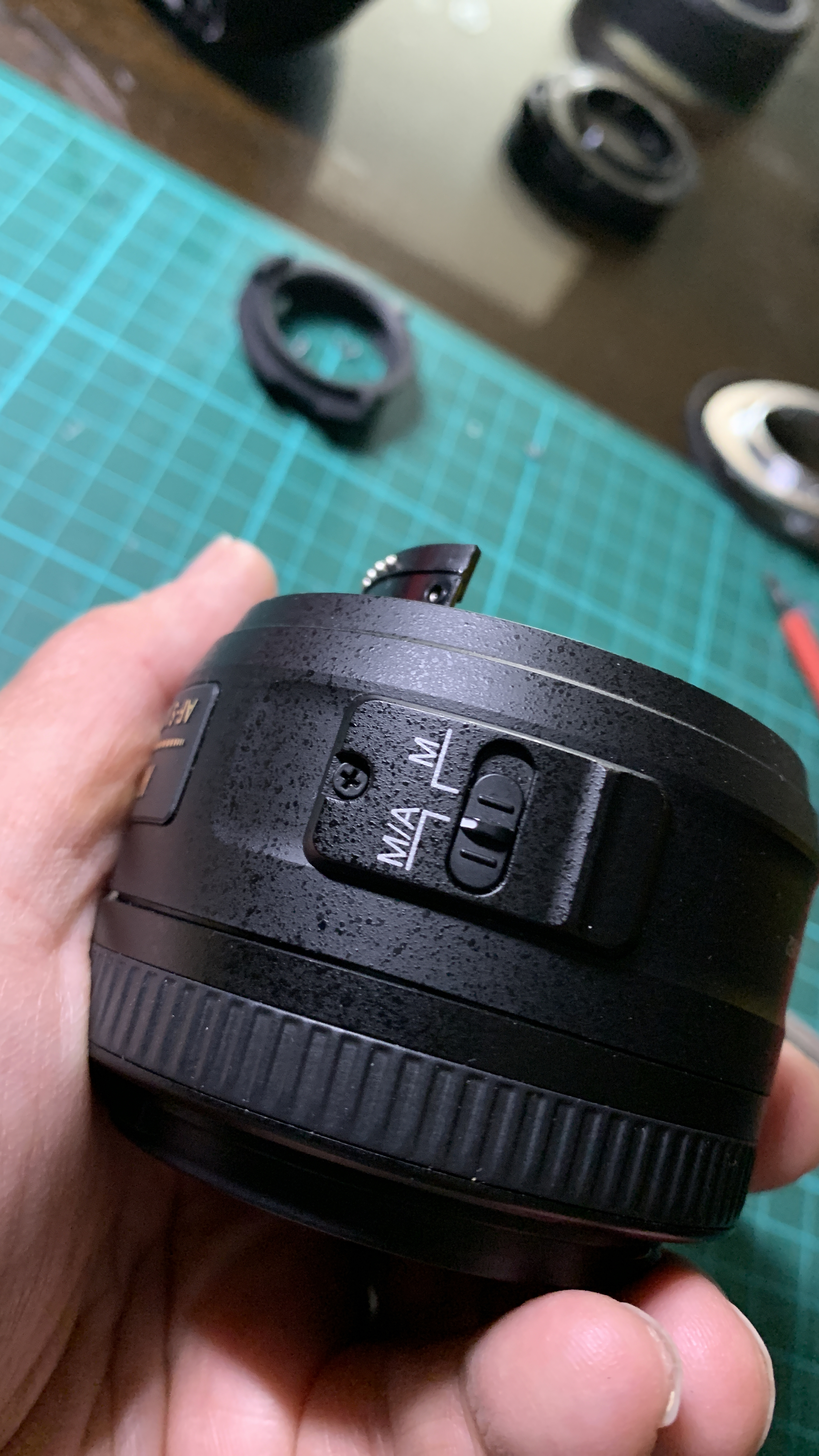
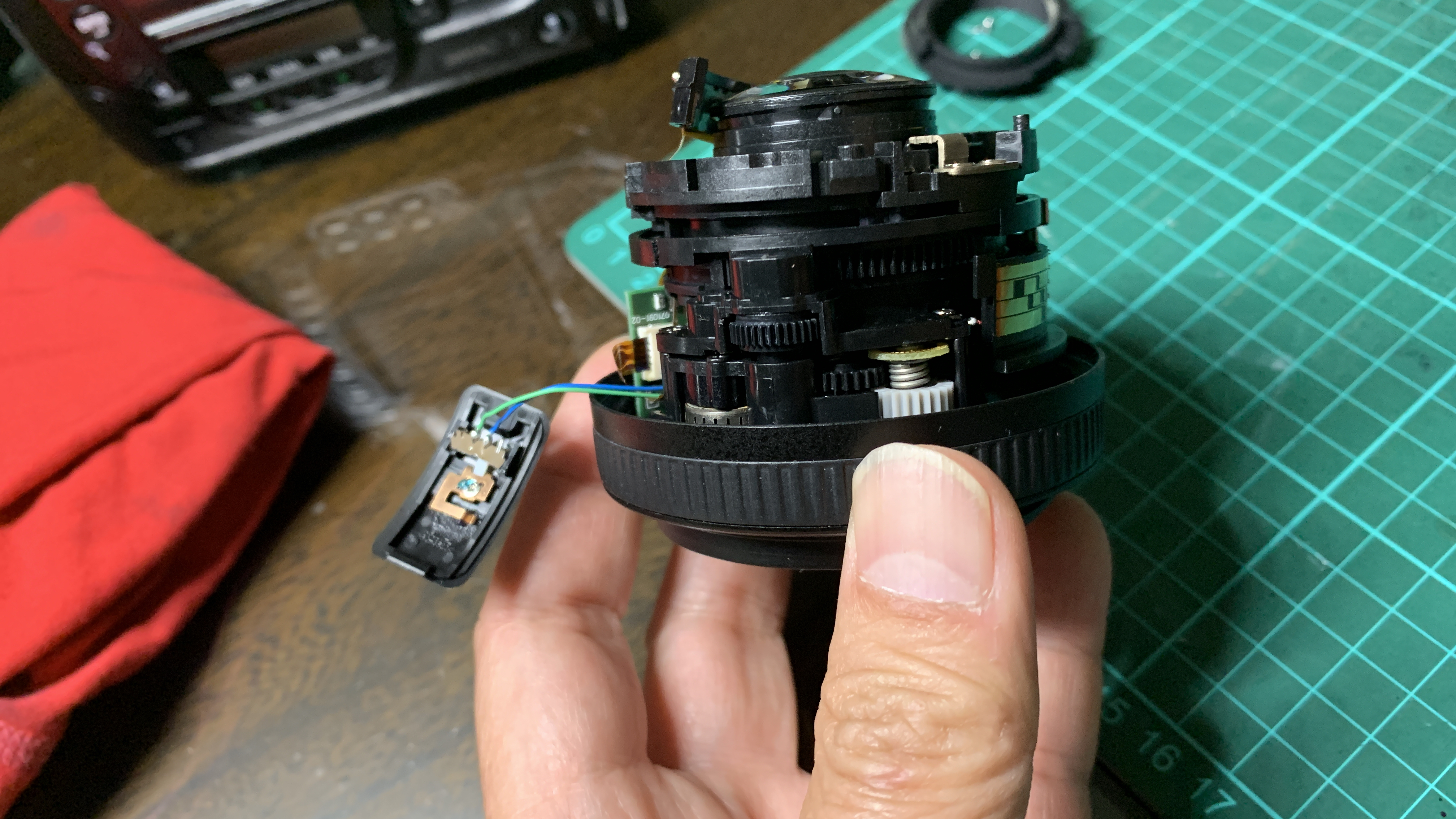
Once the lens mount ring and all the other rings are removed, the next step is to unscrew the single screw holding the focus selector switch in place. After this screw is removed, the lens barrel cover can be slowly slid out to reveal the inside of the lens. However, the focus selector is connected by wires to the CPU, hence, the lens barrel needs to be removed slowly leaving the focus selector dangling by the wires still connected to the main barrel.
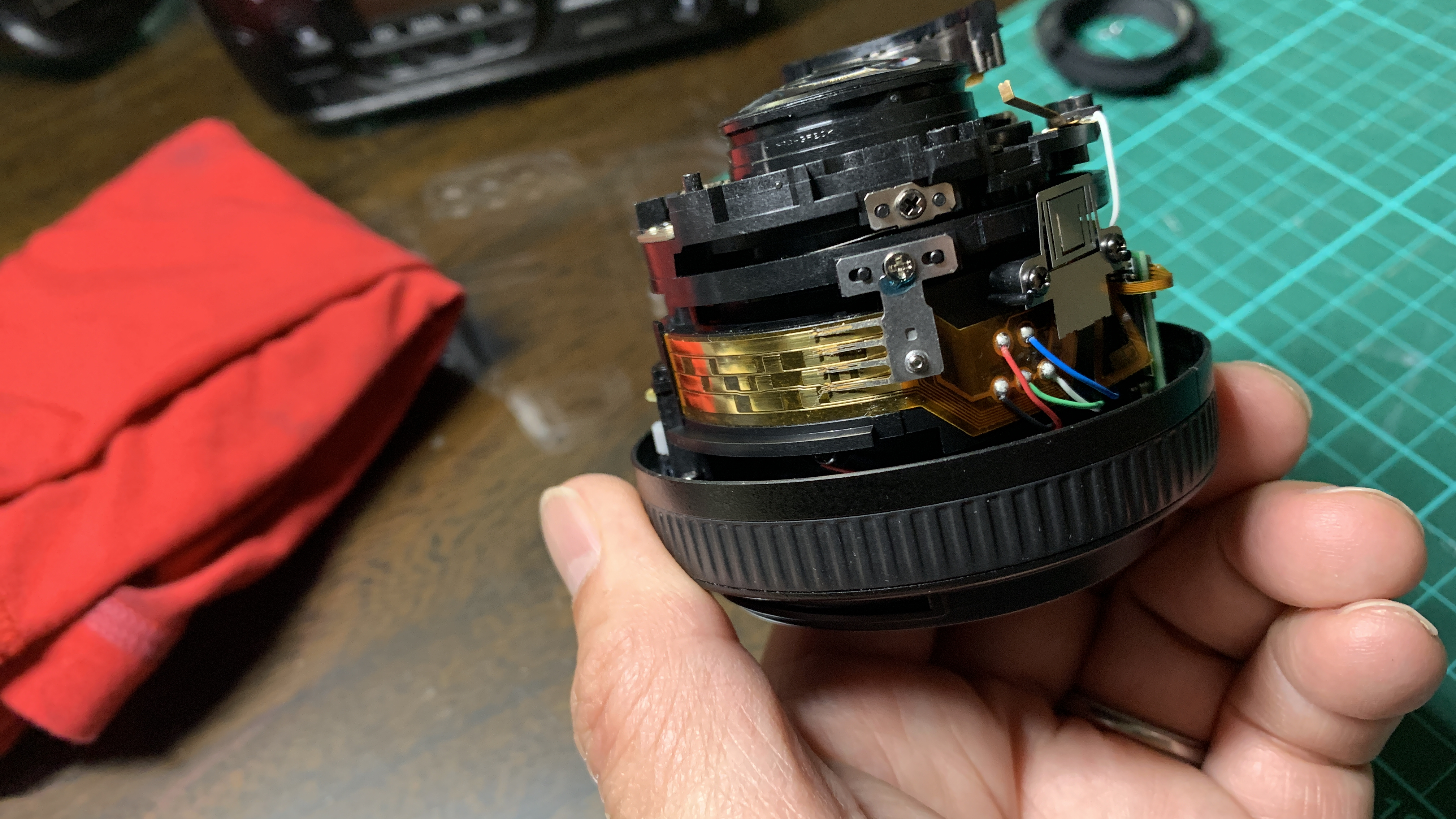
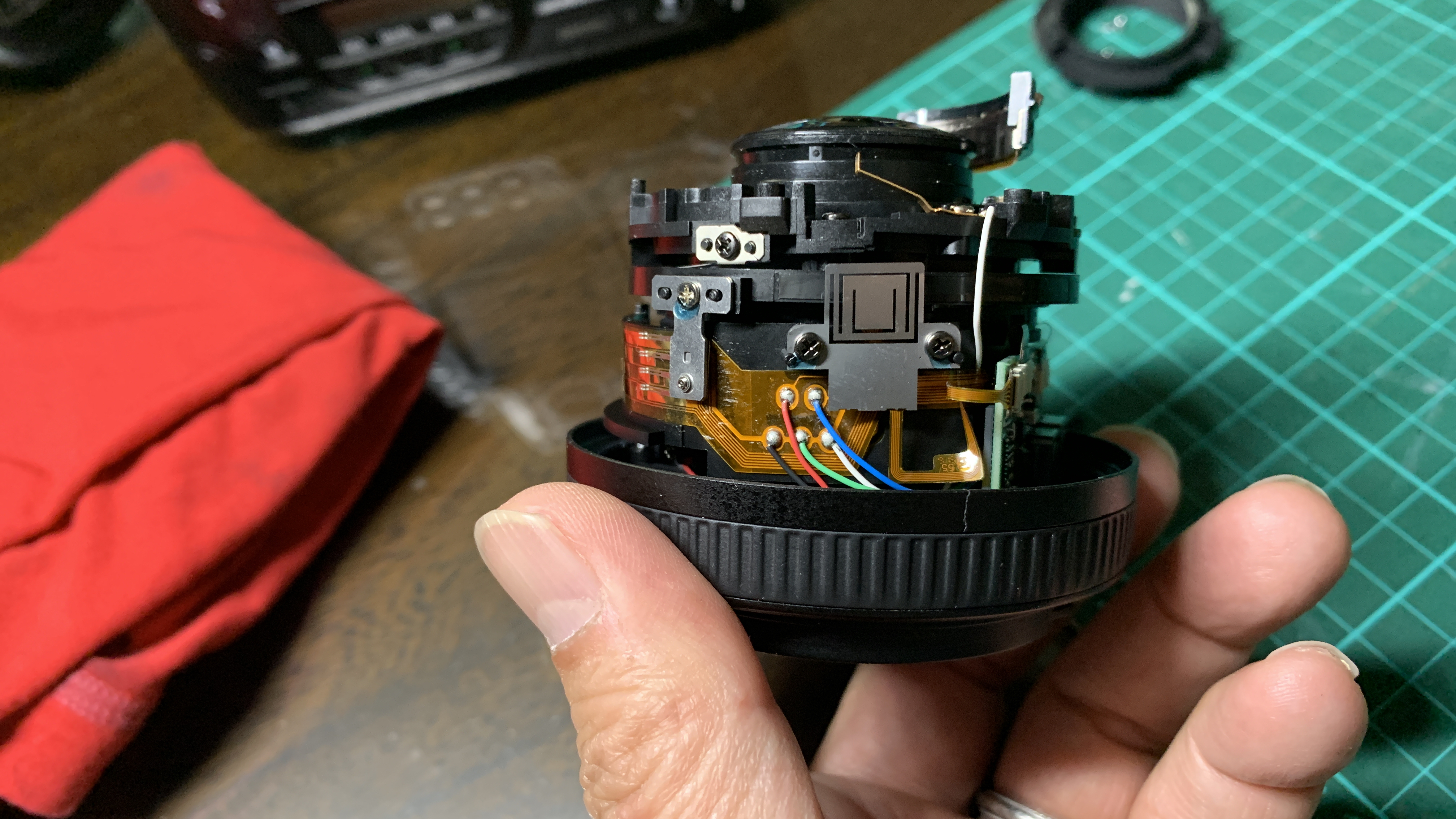
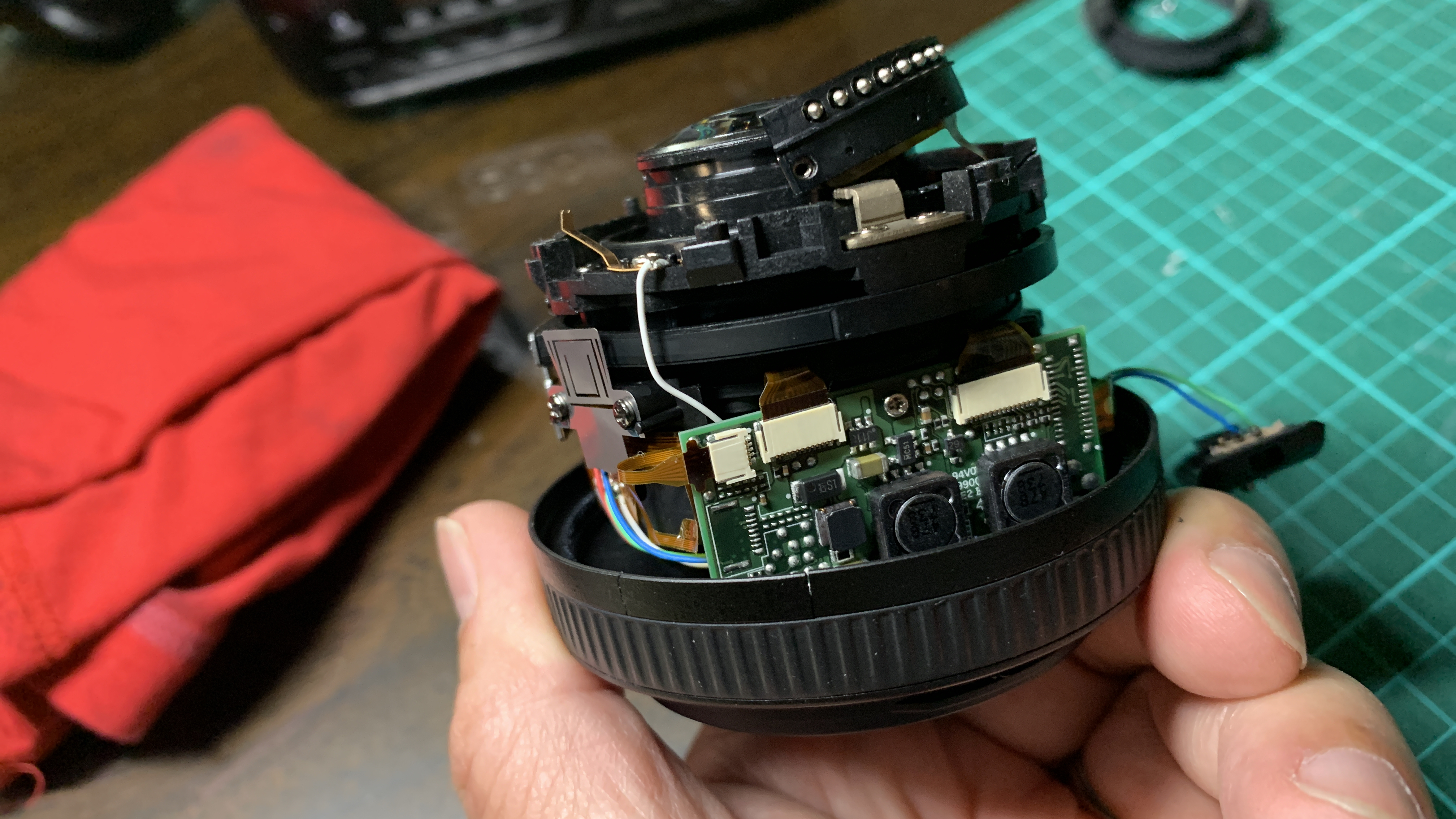
Once the inside of the lens is revealed, you can see the silent-wave motor and focusing mechanism (top left picture), the contact points for correct autofocusing of the lens (top right picture), cables to the lens CPU (bottom left picture) and the lens CPU (bottom right picture). All these are held together on a plastic barrel frame. There is hardly any metal in the barrel. The use of brittle plastic for the barrel frame is another inferior construction feature to keep the cost of this lens low. Even the lens elements are held in plastic frames.
To access the silent-wave motor next, the focusing ring needs to be removed. In the pictures above, the lens is held by the focusing ring.
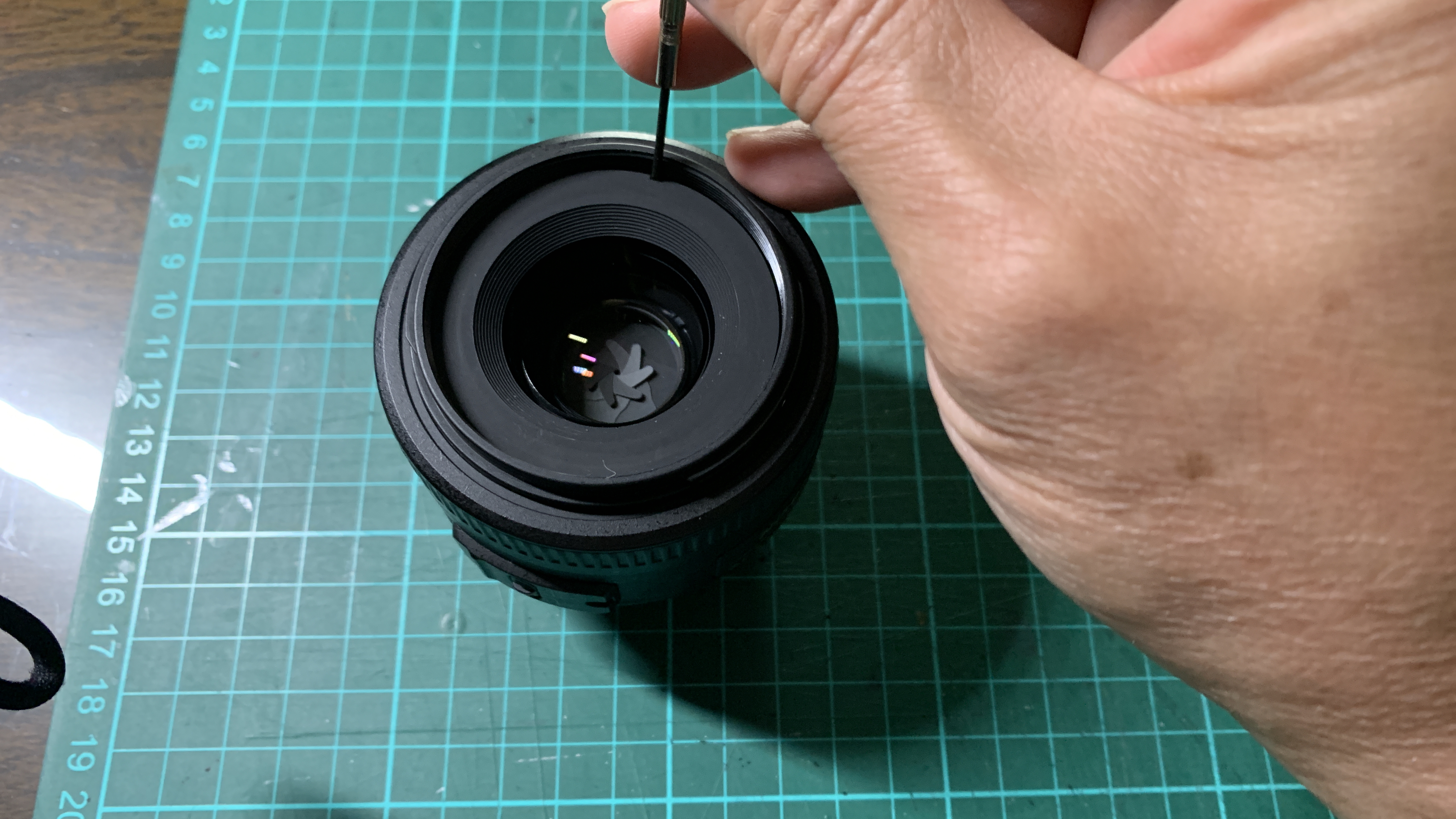
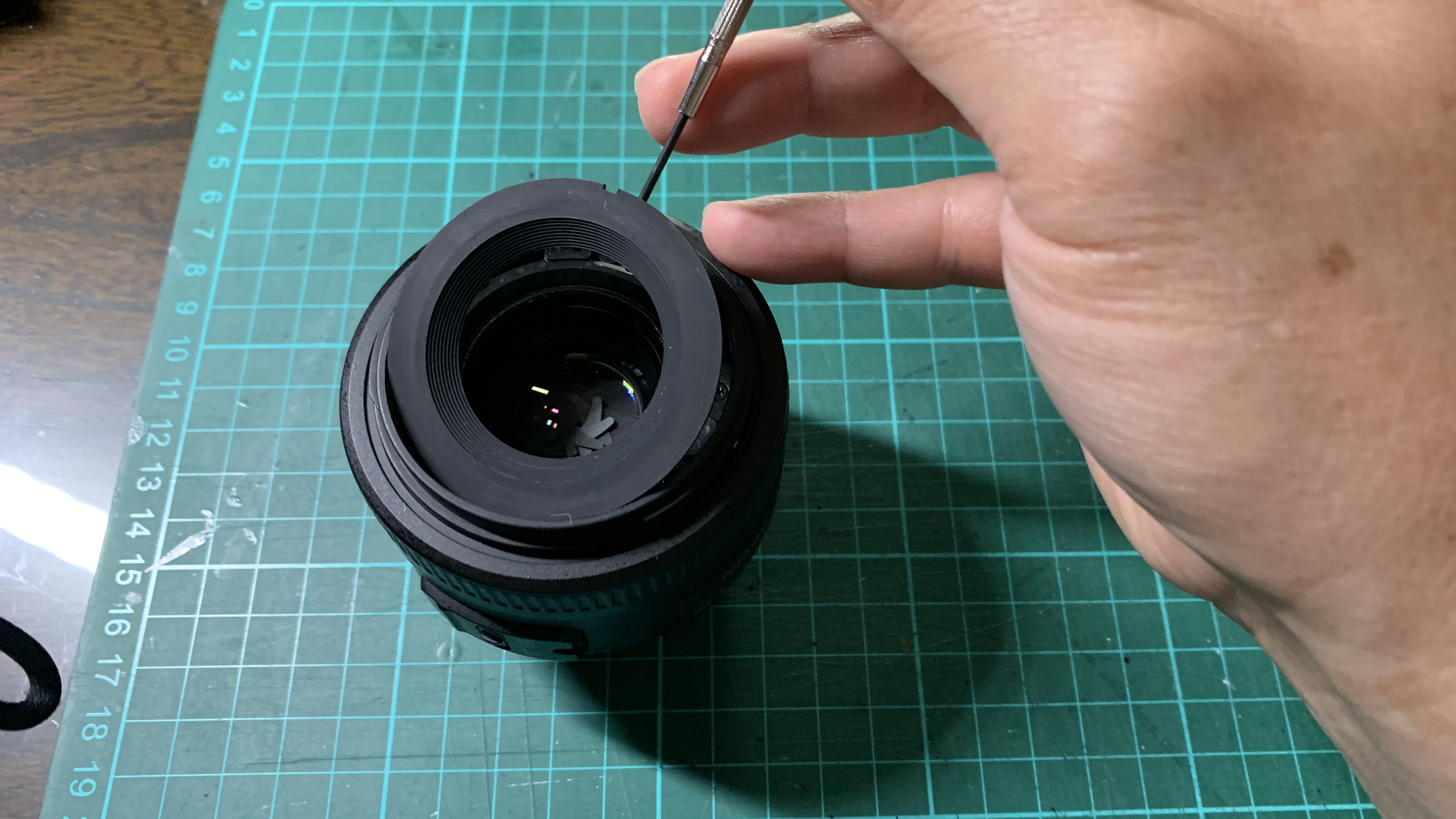
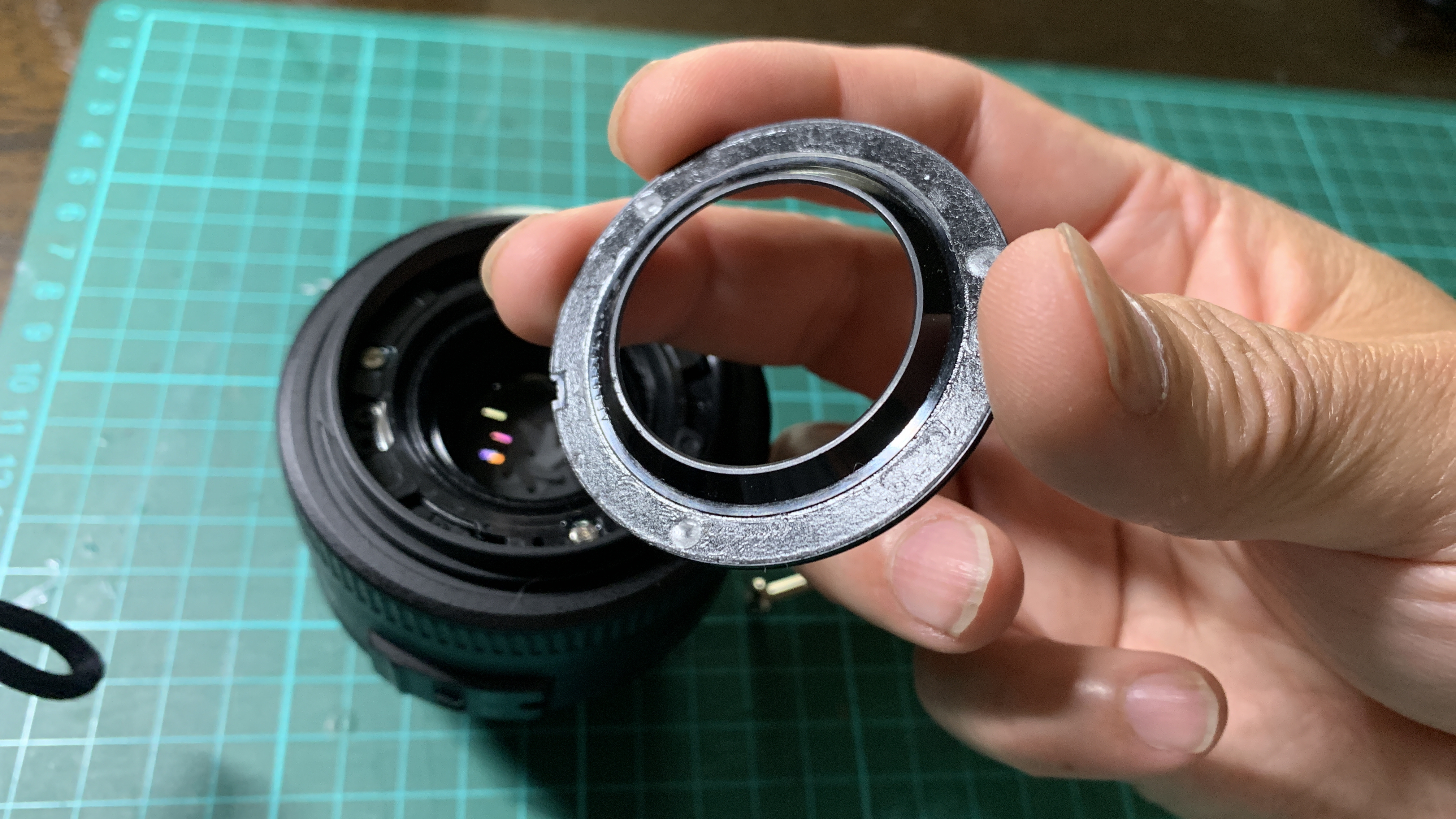
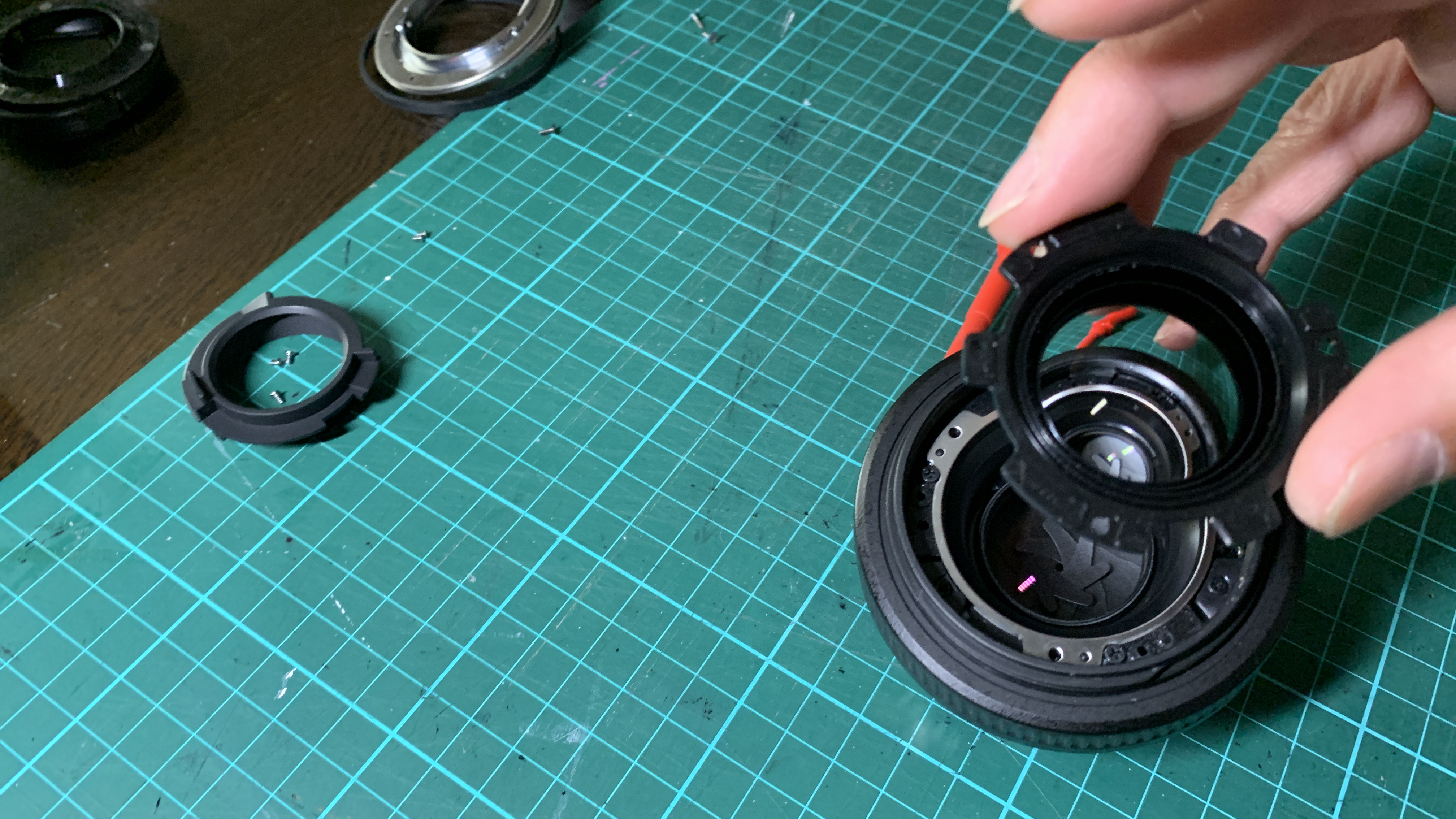
Turning the lens around, the first step is to remove the cover ring to expose the screws holding the focusing ring in place. Initially I was confused as to how to remove it as there is only one notch on the cover ring. Usually there are 2 notches directly opposite each other so that you can use lens ring wrenches to unscrew them. For this cheaper construction this cover ring is held by double-sided tape! All I had to do was to slowly pry it off with a small screw-driver.
There are 2 sets of 3 screws that can be seen once the cover ring is removed. Not sure which ones hold the focusing ring in place, I proceeded to unscrew the metallic screws. Wrong ones! Those hold the plastic frame that houses the front lens element. This is a first time I have seen lens elements housed in plastic frames! Another cost cutting construction by Nikon.
Removing the black screws finally released the focusing ring, which has plastic gear teeth that locks into the focusing gear (plastic as well) of the barrel.
With the motor mechanism exposed, I cleaned the motors and gears with 90% alcohol. After which I reassembled the lens mount but not the barrel cover to check if the lens focussing issues were resolved. Unfortunately, the lens performed no better.
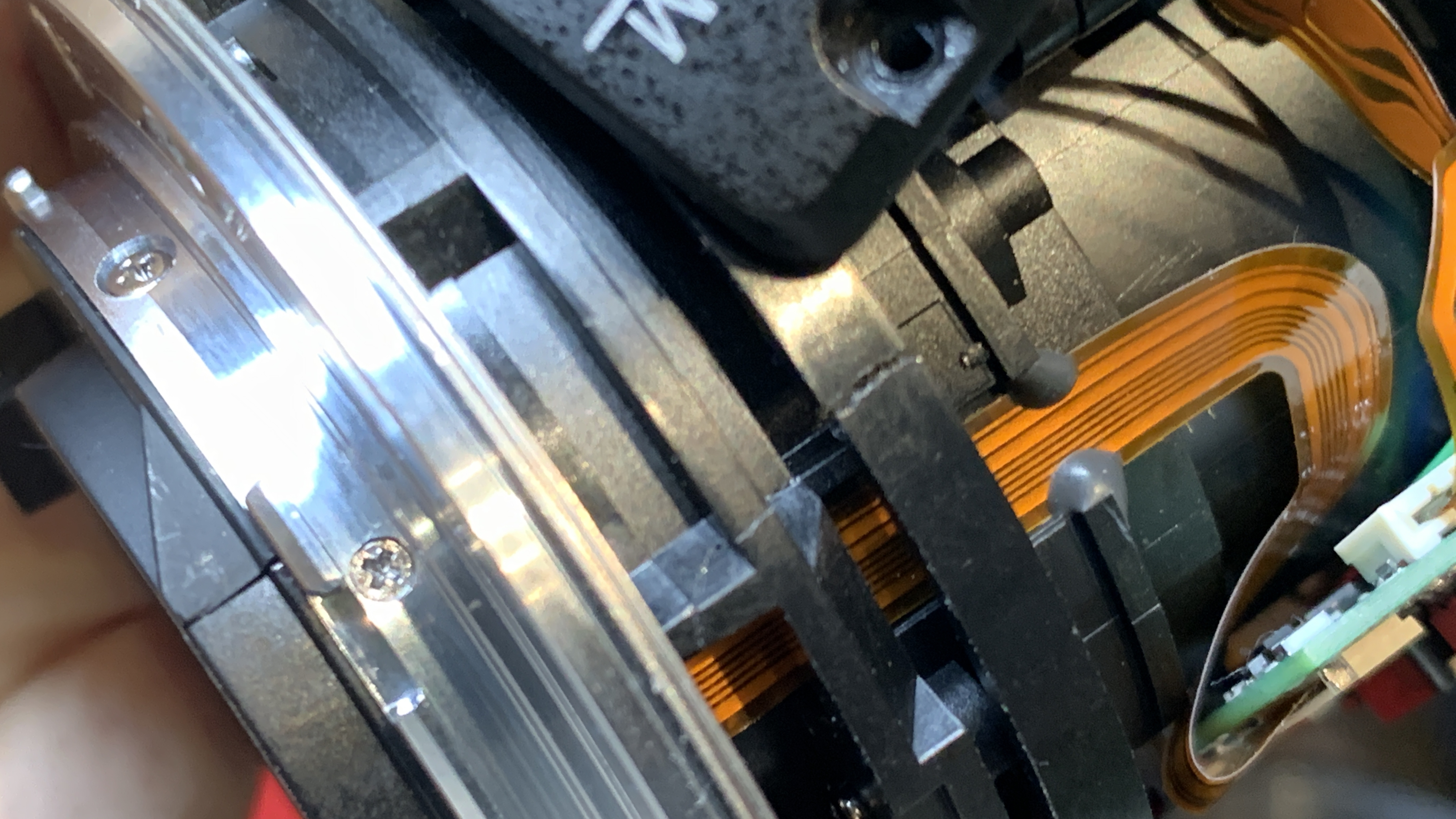
Puzzled, I examined the barrel closer with my loupe. Sad to say, I noticed a crack in the plastic gear that moves the brass auto-focusing contacts. In fact the crack was more extensive, extending diagonally from the base of the focusing ring to the base of the lens mount. What!
The crack completely separates the ring that forms the plastic gear for the auto-focusing contacts. This was obviously the problem.
This lens must have suffered a knock previously and while the damage was not obvious externally, it caused a long diagonal crack in the internal all plastic frame of the lens barrel.
This will never happen in a lens constructed in the 70’s or 80’s, which have far superior metal construction. While the AF-S DX Nikkor 35mm f1.8 G lens looks nice, I wouldn’t recommend it for its cheap all plastic construction. An accidental knock on a wall, or a knock on a lamp post or a drop from the camera bag to a concrete floor will likely render the lens non-functional!
I am sticking to pro-level lenses or old metal lenses even if they don’t have fancy autofocus. The Nikkor of years gone by were quality “glass in metal”!












 AK Siong's Photo Gear Journey